Three research teams Utrecht University awarded National Science Agenda grants

Three research consortiums at Utrecht University have been awarded funding as part of the National Science Agenda Research along Routes by Consortia (NWA-ORC). Each project will receive around 6.7 million euros to immediately start work on a National Science Agenda topic. The projects in Utrecht will focus on the origin of life, the circular society, and healthy air.
PRELIFE – Pathways, Reactions, and Environments leading to LIFE: An interdisciplinary approach
The origin of life is one of the biggest unsolved mysteries in science. There are several theories, but scientists have not come to a consensus. PRELIFE is based on an interdisciplinary approach, in which scientists from the fields of astronomy, biology, earth science, planetary science, computer science, physics, education, chemistry and mathematics all work together to answer the questions: how and under which circumstances did life arise on earth? And how common are those circumstances in the universe? These questions are not limited to the scientific community: society at large would like to find answers too, so teachers, schoolchildren and the general public will be involved in the search by means of educational projects and collaborations with artists and museums.
“How, when and where did life arise? These are questions that can only be answered by a large number of specialist fields working together.” I am therefore overjoyed that we will have the opportunity to do so, and that we’ll be able to share our research with everyone in the Netherlands in a wide variety of ways.”
ACT! Accelerating the Circular Transition. A New Paradigm for Society
The world faces many challenges today: from climate change and biodiversity loss, to excess pollution and scarcity of raw materials. These are all caused by the linear manner in which contemporary societies extract raw materials from the earth and dispose of products and buildings. We desperately need to make a transition to a circular society that re-uses raw materials and is fair to humans and nature. Together with governments, businesses and citizens, Accelerating the Circular Transition (ACT!) will develop a shared vision for that circular society, with a focus on social well-being, simulation models, and an integrated approach to guiding and accelerating this complex transition.
“By 2050, the Netherlands aims to be climate-neutral, circular and less dependent on imported resources. But we don’t really know what a future like that would look like. So in this project, we’ll start researching what a circular society could look like in the year 205, and we’ll take steps towards the transition to that circular society. Just as the name implies, we’ll be Accelerating the Circular Transition, or ACT! for short. We’ll apply our research in tangible case studies, such as the furniture industry and high tech sector. Together with all our partners in this broad consortium, from a repair cafe to two government ministries, we will look forward to collaborating on building a sustainable economy and society in the Netherlands.”
ExpACT: Exposome ACTion perspectives
Almost anywhere you go in the Netherlands, you will be breathing unhealthy air. Air pollution is one of the main causes of illness in the country, and is just as important a risk factor as obesity. Major transitions are currently underway in sectors like mobility, energy and agriculture. They include the transition to electric vehicles, phasing out fossil fuels and woodburning heaters, and making industry cleaner. But this transition also results in heated discussions between governments, businesses and residents.
There is considerable demand for improved technological measurement methods. But it is also increasingly vital that stakeholders are involved in both the collection and analysis of air quality data. In this project, we will focus on strategies for reducing our exposure to air pollutants. We will combine that with creating an open dialogue between various stakeholders.
Combination of expertise
In total, consortiums were able to submit research proposals for one of nine themes. Each project will receive around 6.7 million euros to start working right away. In these projects, researchers collaborate with knowledge partners and social organisations, which provides a combinations of several diverse fields of expertise. The themes vary from a new approach to restoring biodiversity in livestock farming regions, to the consequences of scaling up offshore wind parks.
The National Science Agenda
Responsibility for draughting and renewal of the National Science Agenda (NWA) lies with the citizens. In the NWA programme, connections between society and the scientific community are essential. Governments, researchers, social organisations and citizens develop and utilise knowledge together to create social and scientific impact. Science communications shares the knowledge with society at large, in order to promote involvement and trust in science.
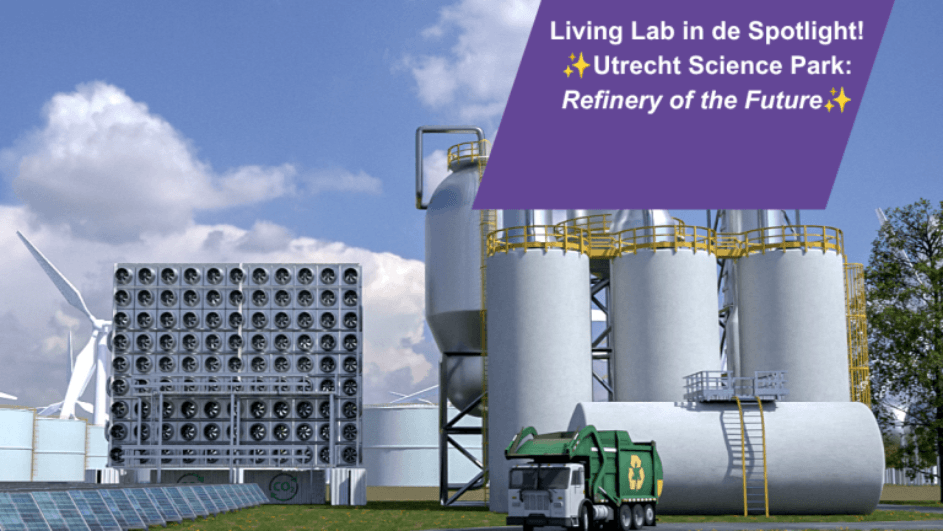
Living Lab in the Spotlight: Utrecht Science Park
Utrecht Science Park is home to several living labs focused on energy and circularity. These include Lumifield, which explores the generation and storage of solar energy, and the biogas digester, which uses organic waste as an energy source. On their own, these are already promising initiatives. Connected, they could become something much bigger: a functioning, learning model for a circular campus.
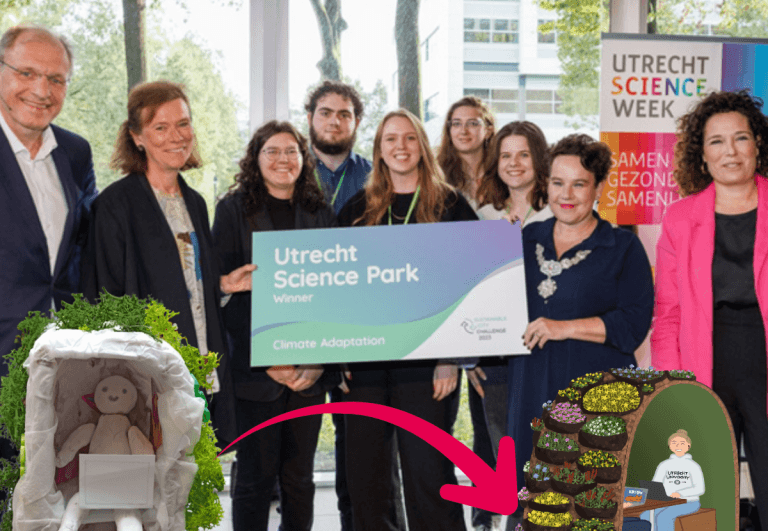
From student idea during challenge to ReGreen Hut at Dutch Design Week
On hot summer days, temperatures can rise significantly at Utrecht Science Park, while students are looking for places to study, relax and find some shade outdoors. At the same time, planting trees is not always straightforward: underground, the campus is crisscrossed by a dense network of cables and utility lines. So how can we create shade, greenery and places to relax without major changes to the ground?
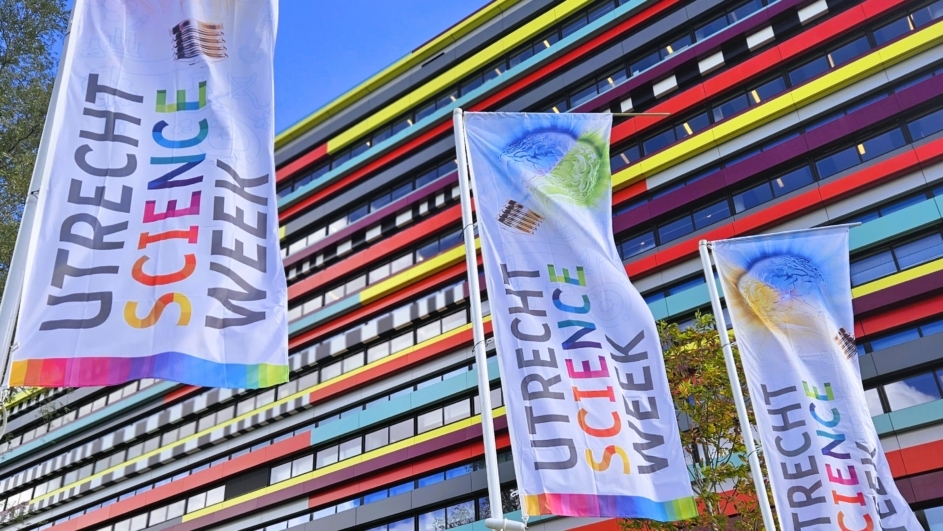
Utrecht Science Week kicks off: social and economic impact of Utrecht Science Park in the spotlight
The sixth edition of Utrecht Science Week takes place from Friday, 25 September to Sunday, 4 October. During this time, Utrecht Science Park opens its doors to the general public, showcasing how research, innovation, and collaboration lead to tangible societal and economic impact. At the same time, the week underscores the importance of sustained investment in knowledge and innovation.
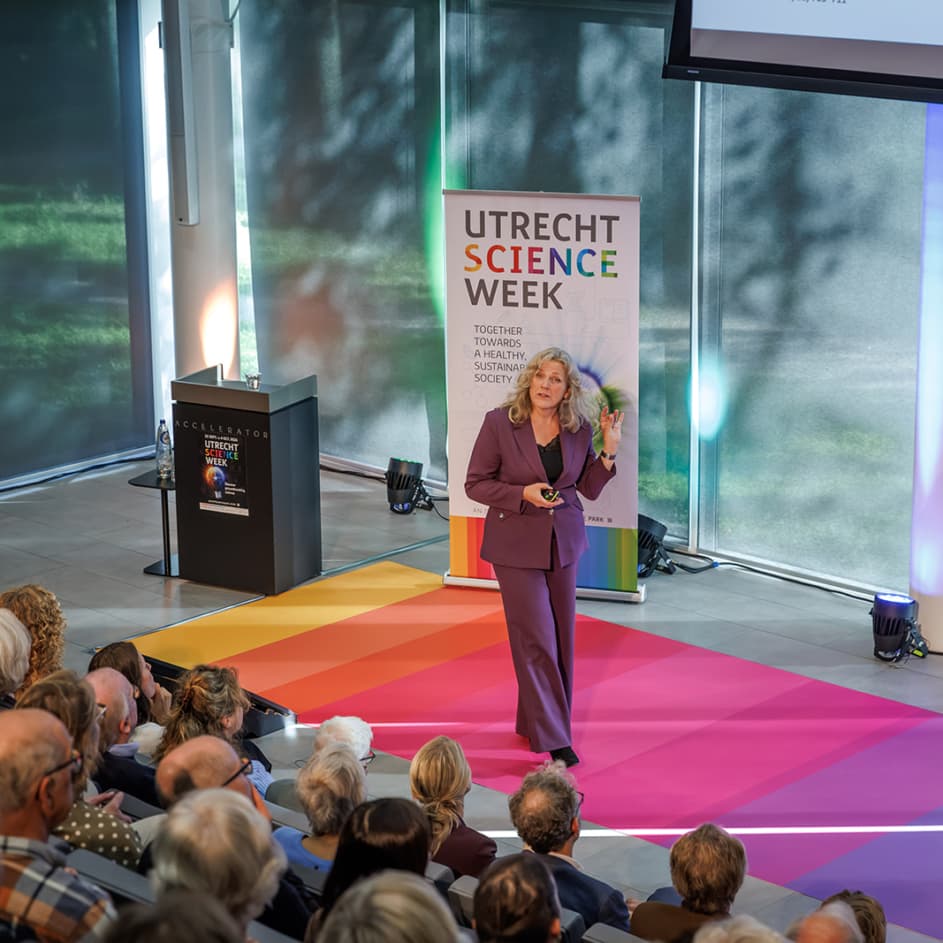
Looking back at Utrecht Science Week: research, education, and entrepreneurship in the spotlight
Utrecht Science Week 2026 has come to a close. For over a week, visitors enjoyed workshops, lectures, group discussions, and tours focused on science and innovation at Utrecht Science Park. With more than thirty program activities across over 25 locations, there were ample opportunities to experience science up close. We look back on a fantastic week that once again highlighted the essential role of collaboration, and the combination of research, education, and entrepreneurship, in addressing the societal challenges of our time.