From student idea during challenge to ReGreen Hut at Dutch Design Week
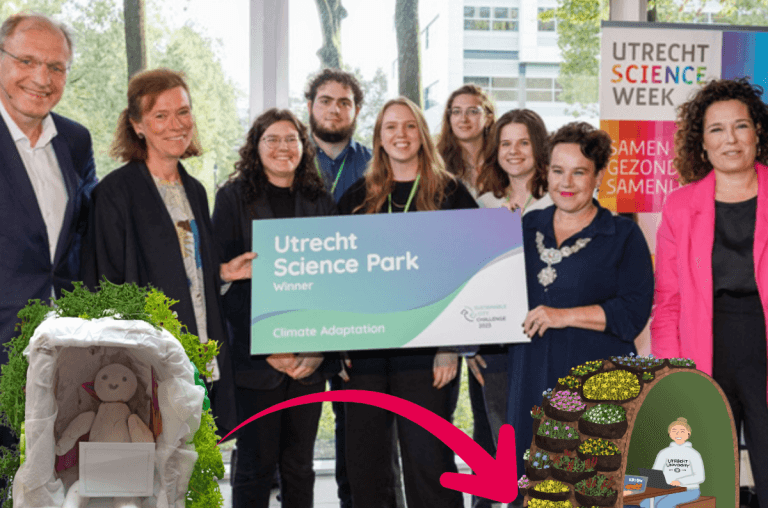
On hot summer days, temperatures can rise significantly at Utrecht Science Park, while students are looking for places to study, relax and find some shade outdoors. At the same time, planting trees is not always straightforward: underground, the campus is crisscrossed by a dense network of cables and utility lines. So how can we create shade, greenery and places to relax without major changes to the ground?
This was the challenge student teams took on during the Sustainable City Challenge. What started as an idea during an intensive challenge week has since developed into the ReGreen Hut, which will be showcased at Dutch Design Week this year.
Stephan Troost, policy advisor for Area Development at Utrecht University, is exploring ways to make the campus more climate-resilient through the Living Lab Healthy Heidelberglaan. From this project, he presented the challenge to the students. “We have a very hot campus in summer,” Stephan explains. “Large-scale greening with trees takes time and is complex because the ground is full of cables and utility lines.”
At the same time, research shows that as many as 86% of students would like to have access to outdoor workspaces. On the paved campus, they are missing places with shade, greenery and shelter from wind, sun and the surrounding activity, where they can study or relax. “We were looking for a small-scale, innovative solution above ground that we could test quickly.”
During the intensive Sustainable City Challenge, several student teams worked on this challenge. One of the teams consisted of five students from different disciplines, including Kir Tulumbasova, who was studying Smart Sustainable Cities at Utrecht University of Applied Sciences at the time.
The first idea for the ReGreen Hut emerged during a brainstorming exercise. Kir was inspired by the library in Middelburg, where she completed her bachelor’s degree. The library had tall, comfortable chairs with a kind of hood around them, allowing people to retreat from the surrounding activity and read in peace. She sketched an outdoor version of these sheltered seating areas.
Erhan Tosun, then a Building Engineering student at ROC Midden Nederland, added another idea: what if the structure could be covered with a special type of cement in which moss could grow? Moss can help reduce noise, purify the air and retain large amounts of water. The name was quickly found: Mosscape, a combination of moss and escape.
The students were enthusiastic, but not everyone was immediately convinced that the idea was feasible. Several challenge coaches questioned the concept and even advised the team to take a different direction. At that point, the team received support from their client, Stephan Troost. “If you really want to do something special, you should go for it.”
It proved to be a decisive moment. The students continued with their idea and built a small clay prototype. On the fifth day, during the final presentation, the jury selected the team as the neighbourhood winner.
The concept stood out because it addresses several challenges at once. The structure provides shade and shelter for students without requiring an underground construction. It also contributes to the ambition of making Utrecht Science Park greener and more biodiverse. The project demonstrates what can emerge when students from different disciplines work together and are given the opportunity to develop their ideas.
Winning the challenge was only the beginning. How do you turn a small clay model into a working prototype that can be tested on campus? In the next part of the Road to Dutch Design Week, we follow Kir as the project continues to develop at Utrecht University. We explore how the first version evolved into the ReGreen Hut and the role fungi can play in nature-inclusive construction.
The team participating in the Sustainable City Challenge consisted of Ella Aula (Energy and Environmental Engineering, Utrecht University of Applied Sciences), Erhan Tosun (Building Engineering, ROC Midden Nederland), Feline van Zwieten (Communication and Multimedia Design, Utrecht University of Applied Sciences), Kir Tulumbasova (Smart Sustainable Cities, Utrecht University of Applied Sciences) and Sterre van der Voort (Creative Business, Utrecht University of Applied Sciences), with Stephan Troost from Utrecht University as the client.
Sustainable City Challenge 2026
This year’s Utrecht Science Week also features the Sustainable City Challenge. Curious about the 2026 challenge? https://usw26-finale-sustainable-city-challenge.events.utrechtsciencepark.nl/