Living Lab in the Spotlight: Utrecht Science Park
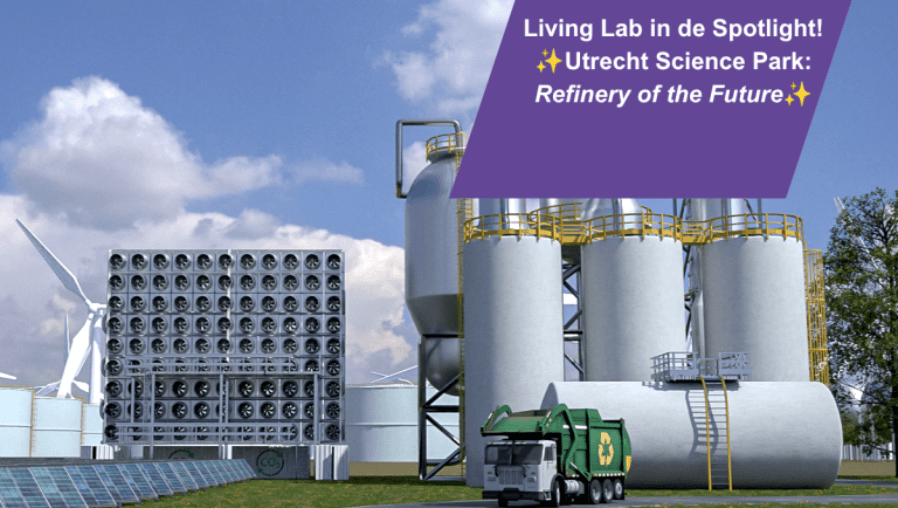
Utrecht Science Park is home to several living labs focused on energy and circularity. These include Lumifield, which explores the generation and storage of solar energy, and the biogas digester, which uses organic waste as an energy source. On their own, these are already promising initiatives. Connected, they could become something much bigger: a functioning, learning model for a circular campus.
That is the ambition behind Refinery of the Future, led by Prof. Bert Weckhuysen (Utrecht University). The project adds two new pieces to the puzzle: converting captured CO₂ into renewable gas and transforming plastic waste into chemical building blocks.
Prof. dr. ir. Bert Weckhuysen
From individual pilots to one ecosystem
Refinery of the Future revolves around two planned facilities: a CO₂ recycling facility and a plastic recycling facility. The first will convert captured CO₂ into renewable gas (methane) using green hydrogen. The second will convert separated plastic waste into valuable chemical building blocks through a process known as pyrolysis.
Both facilities build on research into catalytic processes at Utrecht University’s Institute for Sustainable and Circular Chemistry, and both are designed to connect with other sustainable initiatives and living labs at Utrecht Science Park. The video below explains the science and technology behind the Refinery.
A scientific journey: from fossil to circular
For Prof. Bert Weckhuysen, Refinery of the Future is not the result of a sudden eureka moment, but the outcome of a decades-long scientific journey. When he began his career in Utrecht in 2000, his research focused on converting oil and natural gas. His focus gradually shifted towards biomass and solar fuels, and later towards the recycling of CO₂ and plastics.
As early as 2014, he presented his vision of a city powered by CO₂ in a TEDx talk. In 2024, he and his colleague Eelco Vogt published an article in Nature outlining their vision for the Refinery of the Future. This long-term vision ultimately led to the idea of turning it into a concrete project at Utrecht Science Park. As Weckhuysen puts it: “Why don’t we just build it here, in Utrecht, with students and teachers?”
Passing the baton to the next generation
For Weckhuysen, the driving force behind the Refinery goes beyond technological innovation. Regulation, safety, costs, public acceptance and creating valuable learning experiences for students are just as essential to the project as the technology itself.
He sees the project as a way of passing the baton to the next generation. “Your true legacy is the people you bring forward,” he explains. The planned facilities at Utrecht Science Park should therefore serve as a scientific ‘campfire’: a place where students, researchers and teachers from different backgrounds come together, exchange ideas and work towards new innovations.
A growing, transdisciplinary team
To bring the Living Lab to life, the team is expanding beyond its technical roots, incorporating perspectives from fields including geosciences, law and governance, social sciences and educational sciences.
The project also remains closely connected to other living labs across the campus. What if the neighbouring Lumifield could provide the Refinery with renewable electricity? And how could the Refinery and the Biovergister complement each other in research into residual waste streams?
To move from plans and individual pilots towards a permanent facility at Utrecht Science Park, the team is currently working to secure funding for the necessary equipment. The facilities will become permanent learning environments, offering space for courses, internships and other educational initiatives.
Evolution, not revolution
While the ambition is significant, Weckhuysen emphasises that this is an evolution, not a revolution. The transition towards a sustainable society involves three enormous and simultaneous transitions: in feedstocks, materials and energy. This requires both realism and patience.
“People can be impatient and think there is a button you can simply press,” says Weckhuysen. That is precisely why a living lab on campus is so valuable: it is a learning environment that also leaves room for the inevitable setbacks that come with such complex transitions.
The goal is to map out a pathway towards that point on the horizon: a world without dependence on fossil resources.
Would you like to contribute to the future of the Refinery of the Future by collaborating through your education programme or with your company? Contact us at contact@wijzijngeluk.nl, and we will connect you with the right people.