First patients in UMC Utrecht treated with new technique for heart rhythm disorders
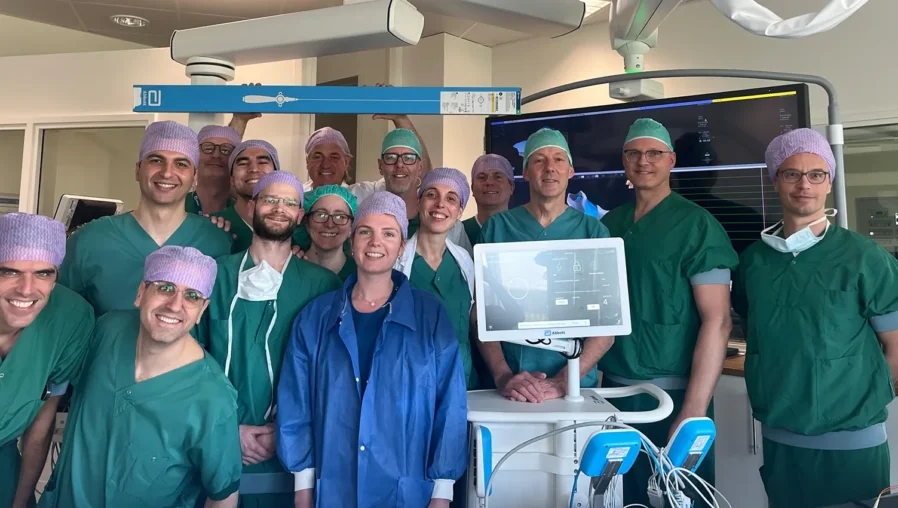
UMC Utrecht, along with three other centers in Europe, successfully treated the first patients with severe cardiac arrhythmias worldwide with Abbott’s new ablation system. This new technique uses extremely short electrical pulses instead of heating or freezing heart tissue. For patients with atrial fibrillation, this technique is safer, more effective and faster. This promising treatment is now expected to be used increasingly in Europe for patients with cardiac arrhythmias.
Atrial fibrillation is the most common cardiac arrhythmia worldwide. In patients with atrial fibrillation, the electrical excitation and conduction in the atria of the heart is disturbed. At UMC Utrecht, together with Abbott, a new ablation system (VoltTM PFA) has been developed with which atrial fibrillation can be surgically treated. This technique consists of a newly developed balloon catheter and uses short electrical pulses (Pulsed Field Ablation). With this, the cardiologist switches off the part of the heart that is causing the arrhythmia. This is done through a tube inserted into the heart through a blood vessel.
Promising new treatment technique
UMC Utrecht is one of the first hospitals in Europe to use the new treatment technique. In total, the first sixteen patients with atrial fibrillation in four centers in the Netherlands, Austria, Germany and Belgium have now been treated with this technique. “It is one of the most startling techniques in electrophysiology, a real game changer,” said Peter Loh, cardiologist-electrophysiologist at UMC Utrecht. “The expectation is that this promising treatment will now be increasingly used in Europe for patients with atrial fibrillation.”
Treatment safer, more effective and faster
Scientific studies show that the treatment is safe and effective for patients with atrial fibrillation. Peter Loh: “Because the electric pulse is ultra-short, essentially no heat is created and, as a result, patients experience few side effects. The treatment is safe and could take place within an hour. This is faster than standard ablation treatment by heating heart tissue, which usually takes two to three hours. The shorter surgery time will likely allow us to offer treatment to more patients.”
Probability of arrhythmia recurrence expected to be reduced
The new treatment technique allows cardiologists to treat the right spots in the heart precisely and effectively. Peter Loh: “We also expect long-term results to improve with the new VoltTM PFA ablation system. After treatment with the existing techniques, about thirty percent of patients develop atrial fibrillation again and often have to undergo a second ablation. With the new system that uses a balloon catheter, the chance of the arrhythmia returning is expected to be reduced, future research will show.”
Eight million Europeans
An estimated eight million Europeans over the age of 65 are currently living with atrial fibrillation. This number is expected to double within 30 years. In the Netherlands, more than 400,000 people have atrial fibrillation. In addition, there are an estimated 80,000 people with atrial fibrillation who do not know because they have never been diagnosed. Atrial fibrillation increases the risk of stroke, heart failure and death.
Interview: Thomas Hoogeboom on the future of Mobility & Health
Healthcare in the Netherlands is at a turning point. The new Societal Impact Platform Mobility & Health aims to connect knowledge and expertise across research disciplines, organizations and societal partners. We spoke to Thomas Hoogeboom, Professor of Physiotherapy Sciences and initiator of the platform, about the importance of mobility for health, the value of collaboration and what to expect from the kick-off during Utrecht Science Week.

How UtrechtInc. helps startups grow
From a promising idea to a startup: getting there takes more than a good idea. UtrechtInc is a startup incubator that supports students, researchers and entrepreneurs in the Utrecht region during the early stages of their startup. Through validation programmes, personal guidance and a network of experts and investors, UtrechtInc helps founders develop and test their ideas.

The new sports season at Olympos has kicked off again
The holidays are over, and the sports season has kicked off again! With packed schedules and tight deadlines, it is tempting to just keep working. Before you know it, you’ve spent hours in front of your screen or in the lab without taking a real break. Especially when things are busy, physical activity can help you unwind and gain new energy and inspiration.

Opening Utrecht Science Week with keynote by Juliette Legler on the hidden influence of environmental chemicals
On Friday, September 25, the annual science festival ‘Utrecht Science Week’ kicks off once again at Utrecht Science Park. We are pleased to announce that this year, Prof. Dr. Ir. Juliette Legler will deliver the Utrecht Science Lecture. Juliette Legler is Professor of Toxicology at the Faculty of Veterinary Medicine at Utrecht University and leads the ‘One Health Toxicology’ group at the Institute for Risk Assessment Sciences (IRAS).