New artificial heart implanted for the first time in Europe
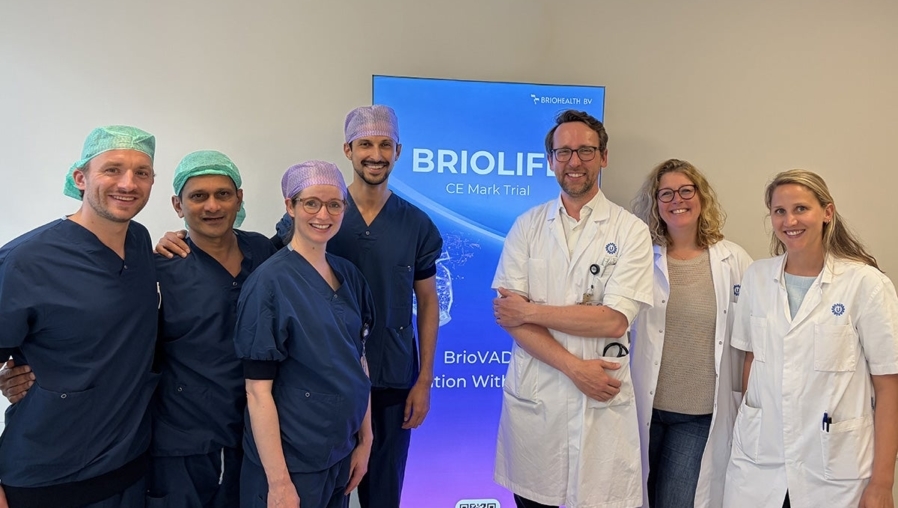
Earlier this month at UMC Utrecht, a patient with advanced heart failure became the first person in Europe to receive a BrioVAD ventricular assist device. The new system is being evaluated in a European study and may offer advantages over the existing ventricular assist device. For UMC Utrecht, the implantation marks a new milestone in a long history of innovation in the field of mechanical circulatory support.
A New Step for Patients with Advanced Heart Failure
For people with advanced heart failure, a heart assist device can make the difference between having barely any energy left and being able to participate in daily life again. A heart assist device, also known as a Left Ventricular Assist Device (LVAD), supports blood circulation when medications or other treatments are insufficient. The device pumps blood from the left ventricle to the aorta, thereby taking over a significant portion of the heart’s work.
Earlier this month, a multidisciplinary team at UMC Utrecht implanted a BrioVAD heart support device for the first time in Europe. The implantation took place as part of the European BRIOLIFE study, in which ten European centers will participate. “This is the first time we’ve been able to monitor this new assist device within a European research context. This will give us greater insight into the system’s performance as well as patients’ experiences,” explain cardiothoracic surgeon Faiz Ramjankhan, the study’s principal investigator at UMC Utrecht, and cardiologist Mariusz Szymanski, who is responsible for patient selection within the study.
For the patient, participating in the study was an important—but also nerve-wracking—decision: “When I heard that I was eligible for this assist device, it felt right almost immediately. Of course, I was nervous about being the first patient in Europe, but I was well-informed and was able to talk to many people about it. In the end, I knew: this is what I have to do. I’m still at the beginning of my recovery process, but I’m incredibly happy that I made this choice.”
What’s new about the ventricular assist device?
The BrioVAD assist device was developed for patients with advanced left-sided heart failure. According to the researchers, the system differs from existing assist devices in several ways. The pump is smaller and lighter, making it potentially suitable for more patients. The external components have also been redesigned, making the system easier to wear and use.
Another notable difference is the power delivery system: the cable that connects the pump inside the body to the controller and batteries outside the body. This cable is thinner and more flexible than in many existing systems. Researchers expect this to improve ease of use and possibly also reduce the risk of infections.
The European BRIOLIFE study aims to provide more insight into the system’s performance and patients’ long-term experiences. Szymanski explains: “The BrioVAD has features that make it an interesting system to study, such as its compact design and flexible power delivery system. At the same time, we don’t yet know exactly what that means for patients and their quality of life in everyday practice. That is precisely why this study is important.” Ramjankhan adds: “The fact that UMC Utrecht is the first center in Europe to participate fits in well with our many years of experience in ventricular assist device care and research.”
History of Heart Support Devices at UMC Utrecht
The implantation of the new assist device builds on more than thirty years of experience with assist devices at UMC Utrecht. In 1993, the first Dutch patient received a ventricular assist device in Utrecht. This made UMC Utrecht one of the pioneers in the field of mechanical circulatory support in the Netherlands.
Since then, the treatment has undergone tremendous development. While ventricular assist devices were originally used primarily as a bridge to a heart transplant, they are now also used as a long-term treatment for patients who are not eligible for a donor heart. There are now patients who have been living with a heart support device for as long as fifteen years. At the same time, the systems have become smaller, more reliable, and more user-friendly.
UMC Utrecht is also at the forefront in other areas of mechanical cardiac support. For example, in 2021, a fully implantable artificial heart —which completely takes over the heart’s function—was implanted for the first time in the Netherlands.
The Utrecht program is characterized by multidisciplinary collaboration among cardiologists, cardiac surgeons, nurses, and researchers, among others, to care for patients with a ventricular assist device. There are now four specialized centers in the Netherlands that implant ventricular assist devices, one of which is UMC Utrecht.
Each year, approximately forty patients at UMC Utrecht receive a ventricular assist device. Of the approximately 400 people currently living with a ventricular assist device in the Netherlands, about half were treated at UMC Utrecht. This makes UMC Utrecht the largest ventricular assist device center in the Netherlands.
With the first Dutch implantation of the BrioVAD, UMC Utrecht is taking the next step in the development of ventricular assist device care.
For doctors and researchers, the implantation marks the beginning of a new phase in which they will gain experience with this new generation of ventricular assist devices.
For the patient, the coming period will be primarily focused on recovery and rehabilitation. “I need to take it easy now and build up my stamina step by step. My biggest goal is to be able to play outside with my little boy again soon. I’m looking forward to having the energy again for my family, my hobbies, and the simple things in life.”