Heineken Young Scientists Award for Miguel Leung
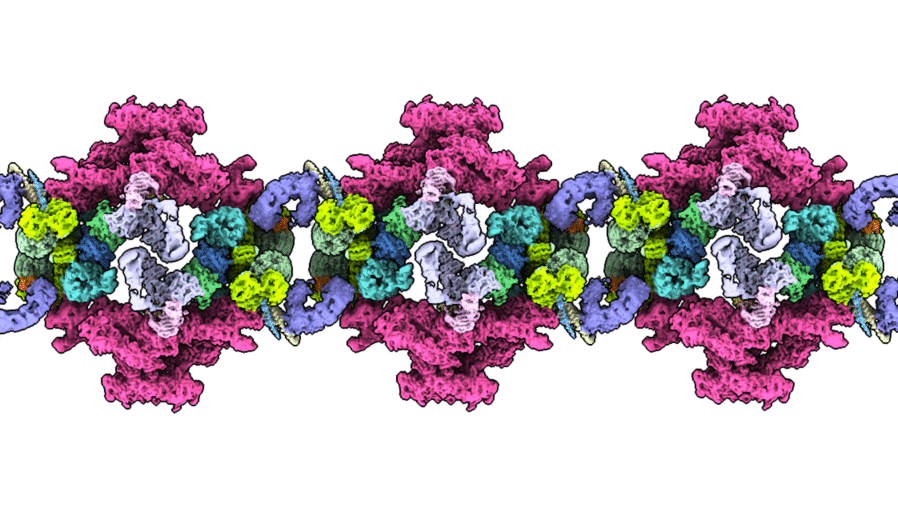
Miguel Leung, group leader at the Hubrecht Institute since 2024, has been awarded the Heineken Young Scientists Award 2026. This award recognizes young researchers who have made outstanding scientific achievements, setting an example for other young scientists. With his research group at the Hubrecht Institute, Miguel Leung investigates the 3D structure of protein complexes, tiny machines at work inside each of our cells. The group focuses on highly specialized cells that perform specific functions, such as sperm and egg cells.
One of the major structures that Leung has solved is the molecular machinery that powers the movement of the sperm tail. Similar machinery is found in other cells, driving processes such as the flow of the cerebrospinal fluid in the brain and the movement of cilia in the respiratory tract. The Leung group discovered that the sperm tail has many additional proteins that make the machinery more elaborate and may support the sperm in its long journey towards the egg. Recently, they made new discoveries in oocytes as well, revealing the structure of their storage complexes.
Recent discovery of storage complexes in oocytes. Credit: Miguel Leung. Copyright: Hubrecht Institute.
An unexpected honor
Leung was not aware of his nomination, so he was very honored to learn that he was awarded the prize. According to him, the fact that somebody thought highly enough of his work to nominate him is an even bigger honor than the prize itself. He saw it as a really nice win for the field and also as a reminder to keep going and work hard. “This prize is a good reminder to keep exploring. It is super rewarding to go from not even knowing what was potentially possible with a method to then being able to make a meaningful difference,” Leung says.
A visual field
The field of structural biology is interesting to Leung because it considers the fundamental molecular building blocks of life. “It’s so interesting to use structural biology to investigate the earliest stages of the development, which we know very little about at the molecular level,” Leung explains. His group uses cryo-electron microscopy (cryo-EM), a technique that freezes cells or proteins so rapidly that water does not have time to form ice crystals. “Thanks to cryo-EM, the proteins are trapped in a frozen state without using chemicals that could distort their structure,” Leung explains.
Visualizing protein complexes is helpful for understanding how cellular processes work. Leung explains it using the example of tulip fields in the Netherlands: “If somebody tells me about these, how am I supposed to know what they look like until I actually go there and see these dramatic fields full of flowers? I need to see it to wrap my head around the complexity – and the beauty – of the system.”
About the award
The Heineken Young Scientists Award recognizes young researchers who have made outstanding scientific achievements. It includes a monetary award and a trophy. The awards have been presented since 2010, and as of 2018, four awards are presented in different domains: (bio)medical sciences, humanities, natural sciences and social sciences.
Miguel Leung received the award in the category of (bio)medical sciences.