Biology students record more than 500 different species in a single day at Utrecht Science Park
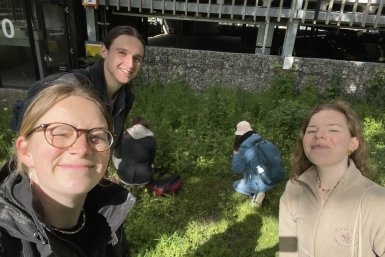
This year, 1081 species have already been recorded at Utrecht Science Park during the Biodiversity Challenge, a nationwide initiative in which fifty educational institutions are studying biodiversity on and around their campuses. Biology students in Utrecht alone managed to document at least 573 species in a single day.
On 12 May, more than 300 first-year biology students made a major contribution to the Biodiversity Challenge. During the so-called “BioBlitz”, they spread out across campus to record plants, animals, and fungi. Understanding what is present is important, as biodiversity underpins a healthy environment: it supports pollination, fertile soil, clean water, cooling, and a campus where both people and nature can thrive.
“For many students, this first-year module is their first introduction to ecology, so it is important to show them how engaging and relevant the field can be,” explains Utrecht-based ecologist and co-organiser Jonas Lembrechts. “Getting out into the field is essential, because an ecologist needs to develop a sense for how ecosystems work. In the BioBlitz, students use a methodology that we also apply in our own research. The data they collect is linked to a real-world management question: how can we improve biodiversity at Utrecht Science Park?”
Wading suits and butterfly nets
To record all these species accurately, the students used the ObsIdentify app on their phones. They simply took a photo of the organism they encountered, after which the app helped identify it and allowed the observation to be uploaded immediately.
The first-year students were divided into groups, with each group assigned a specific species group or habitat to study in detail. This ensured that plants, animals, and fungi that are less visible or restricted to particular habitats were also recorded. Wearing wading suits and equipped with buckets and nets, students explored the ditches. They examined ditch water samples under microscopes to identify algae, collected flying insects using butterfly nets, searched tree bark with magnifying glasses for small organisms, and closely studied soil-dwelling organisms.
Unique locations
The groups were strategically distributed across the entire campus. This meant that students not only surveyed the more familiar areas, but also the outlying fields and green spaces that are part of the campus. During the BioBlitz, the first-year biology students also had access to normally restricted areas, such as the Fort Pond in the Botanic Gardens and the Tolakker.
Barred grass snake in the Botanic Gardens
This approach proved successful: working together, the students surveyed a large part of the campus and recorded a wide range of species groups. On 12 May alone, they documented a total of 573 species, including plants, birds, and other taxa. Among them were no fewer than 25 species of mosquitoes and flies, several species of fish, and even a barred grass snake in the Botanic Gardens. Around 500 additional species are still awaiting moderator approval, meaning the total could exceed 1000.
Diversity of the landscape
In total, more than 1000 verified species have already been recorded at Utrecht Science Park during the Biodiversity Challenge this year. Is that a lot?
“That’s certainly not bad,” says Lembrechts. “It reflects the diversity of the landscape at Utrecht Science Park. The green corridors, nearby nature reserves such as De Driehoek, and the organic farming areas at De Tolakker all contribute to this. At the same time, reaching those numbers is perhaps easier than you might think when you work together. You would be surprised by how many species are present in a country like ours. Some people even manage to record 1,000 species in a single garden.”
Join!
This day was part of the national Biodiversity Challenge, which runs from 1 May to 1 July. There is still plenty to discover, as not all species on campus have been recorded yet. Staff and students are encouraged to contribute by submitting their own sightings on campus via the ObsIdentify app or by joining one of the activities. In this way, they can help improve understanding of biodiversity in the Netherlands, and on campus in particular.
Tips
Jonas Lembrechts offers some tips on how to discover new species. “Although we have already made a special effort in this area, there is still much to discover among the less ‘photogenic’ species groups. We have really only scratched the surface of what is present in our soils, for example, and there is still a lot missing when it comes to lichens and tiny insects. So take a look among fallen leaves and in the topsoil, you would be surprised by how much can still be found there. I would also keep a close eye on the verges. That is where I expect the greatest improvements in terms of management, because they can be made more ecological quite quickly by mowing less and introducing more plant species. Last week, we found more than twenty plant species in just one square metre of roadside verge.”