Detecting rare form of dementia with AI
Imagine this: you are in your mid-40s and in the middle of life. Yet you slowly but surely notice that you start having trouble finding the right words during conversations. Out of shame, you increasingly withdraw from social situations, become insecure and experience stress. People around you do not understand what is wrong with you. Meanwhile, you can no longer work either; e-mailing and meetings are no longer possible. To your surprise, you are diagnosed with burnout, but despite psychological treatment and medication, your language skills continue to deteriorate. And so years go by with no prospect of improvement.
The situation described above is unfortunately still the reality for many people with Primary Progressive Aphasia. Primary Progressive Aphasia (PPA) is a rare form of dementia, in which symptoms begin before the age of 65. In PPA, problems in language and/or speech (‘aphasia’) develop and gradually increase. This is because in PPA, the language area in the brain is affected. Roelant Ossewaarde, researcher at the Artificial Intelligence lectorate, says: ‘We know an awful lot about what happens in the brain when children and adults learn a language, but still very little about the emergence of gradual language problems in non-congenital brain injury.’
Years of search
Roelant recently received his PhD from the University of Groningen with his research on the use of machine learning in the diagnosis of Primary Progressive Aphasia. ‘Because PPA is relatively unknown, it is often diagnosed late or incorrectly. For example, as sudden aphasia after a stroke, or as a psychological problem. Patients have sometimes already had years of searching for it and during all this time received no, or not the right care and support.’
In the research, he combined his background in linguistics with his work in ICT. ‘Unlike the most common forms of dementia such as Parkinson’s and Alzheimer’s, in PPA factors such as forgetfulness and change in behaviour do not initially play a role. Besides brain scans, specific, comprehensive language tests are therefore needed to diagnose PPA. Moreover, there are three variants of PPA, with slightly different characteristics. My PhD research shows that software can not only recognise the difference between people with and without PPA, but through machine learning can even learn to distinguish the three forms of the disorder.’
Primary progressive aphasia: the three variants
In the non-fluent variant of PPA, the first thing that becomes more difficult and unclear is speaking. A kind of ‘telegram style’ in speaking often develops. In the semantic variant, people develop problems with the meaning of words. Digging up the meaning of (less frequently used) words from word memory then becomes increasingly difficult. Finally, people with the logopenic variant develop word-finding problems.
Subtle differences in language use and fluency
PPA patients start speaking in a different rhythm, dropping more pauses and saying ‘uh’ more often to fill the pauses. Roelant: ‘These pauses, for example, however subtle, have certain patterns that we can measure with the software we developed.’ For his research, Roelant worked with patients at Amsterdam UMC’s Alzheimer’s Centre, among others. ‘For example, the software learned the difference between the language of people with PPA and healthy people, recognising especially well the non-fluent variant.’
The sub-studies of the research focused on how fluent the participants’ language sounded, what kind of words they used and how precise the description of the pictures they had to describe was. Roelant: ‘Although people with the semantic variant of PPA sound relatively normal to us, the software nevertheless recognised the subtle differences in language use and fluency.’ Eventually, Roelant developed a machine learning model that can predict with 90% accuracy whether someone has PPA, and with 85% accuracy which partial variant of it.
Prospect
In short: with AI, we can identify issues earlier and more accurately, so that patients get the right care faster. Roelant: ‘This research not only shows how technology improves healthcare, but also humanises it by giving people with complex and rare diseases like PPA a voice. My PhD research has now found a place within the YOD-MOLECULAR consortium, which is doing major research on dementia in younger people. For the HU, my research is a starting point for working through to practice. My big dream is that we will soon be able to use simple language research to better test for PPA!’
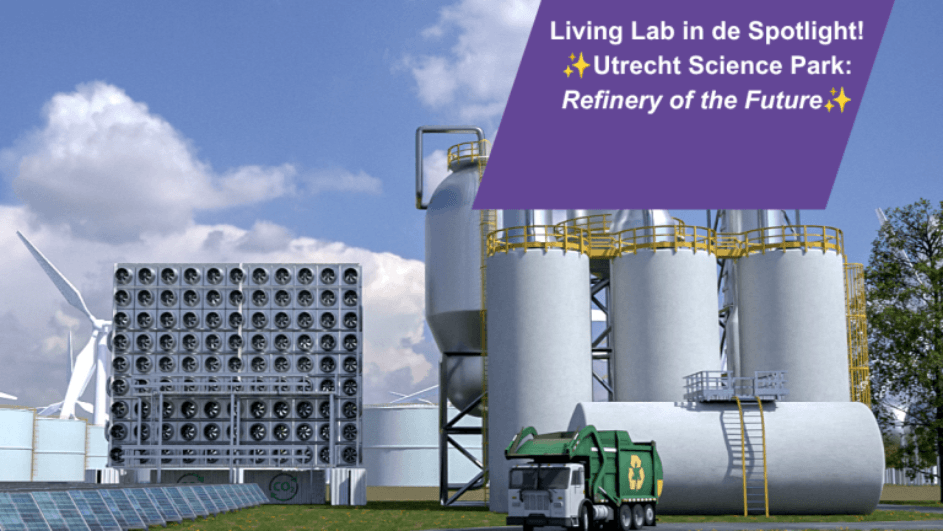
Living Lab in the Spotlight: Utrecht Science Park
Utrecht Science Park is home to several living labs focused on energy and circularity. These include Lumifield, which explores the generation and storage of solar energy, and the biogas digester, which uses organic waste as an energy source. On their own, these are already promising initiatives. Connected, they could become something much bigger: a functioning, learning model for a circular campus.
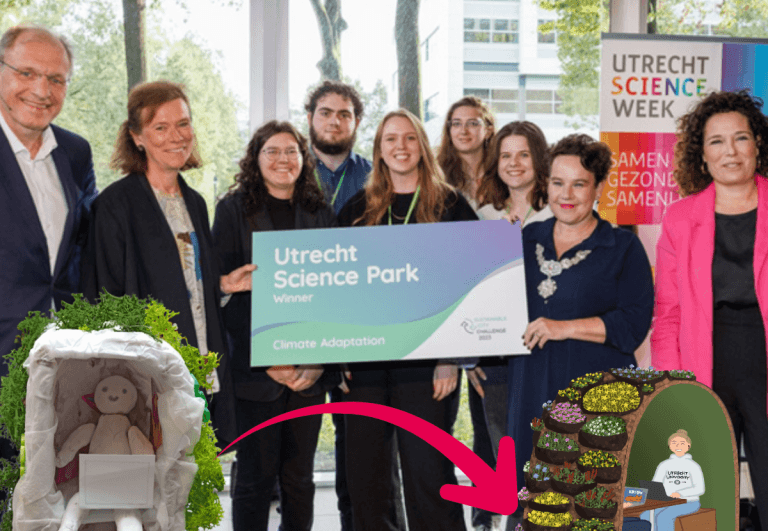
From student idea during challenge to ReGreen Hut at Dutch Design Week
On hot summer days, temperatures can rise significantly at Utrecht Science Park, while students are looking for places to study, relax and find some shade outdoors. At the same time, planting trees is not always straightforward: underground, the campus is crisscrossed by a dense network of cables and utility lines. So how can we create shade, greenery and places to relax without major changes to the ground?
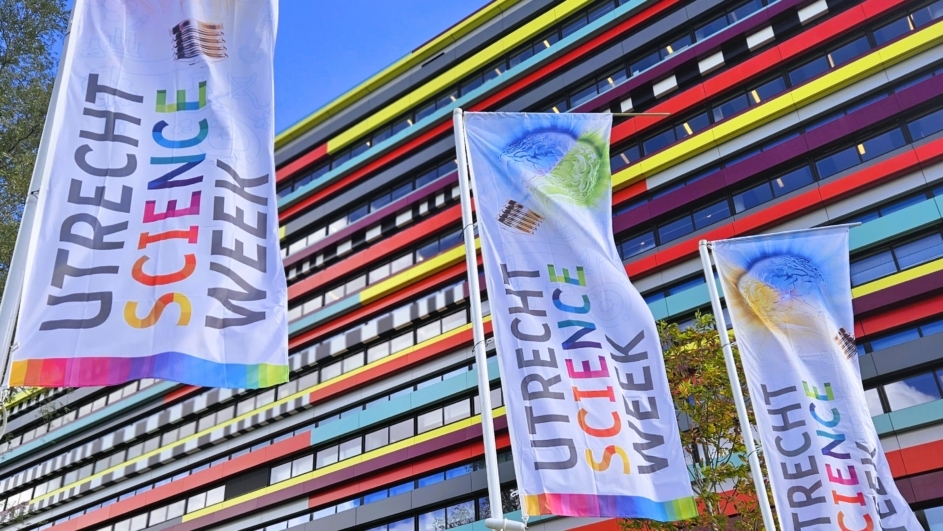
Utrecht Science Week kicks off: social and economic impact of Utrecht Science Park in the spotlight
The sixth edition of Utrecht Science Week takes place from Friday, 25 September to Sunday, 4 October. During this time, Utrecht Science Park opens its doors to the general public, showcasing how research, innovation, and collaboration lead to tangible societal and economic impact. At the same time, the week underscores the importance of sustained investment in knowledge and innovation.
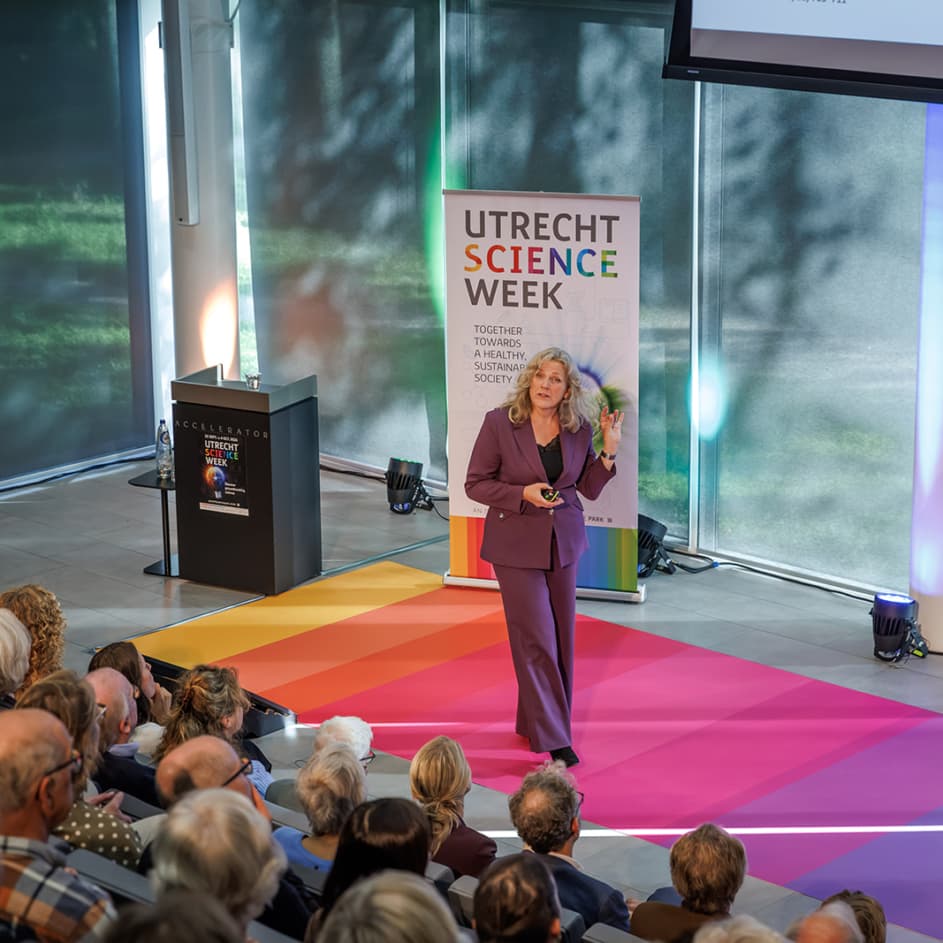
Looking back at Utrecht Science Week: research, education, and entrepreneurship in the spotlight
Utrecht Science Week 2026 has come to a close. For over a week, visitors enjoyed workshops, lectures, group discussions, and tours focused on science and innovation at Utrecht Science Park. With more than thirty program activities across over 25 locations, there were ample opportunities to experience science up close. We look back on a fantastic week that once again highlighted the essential role of collaboration, and the combination of research, education, and entrepreneurship, in addressing the societal challenges of our time.