UMC Utrecht Measures Brain Waves Live at Lowlands
The lights are flashing, the music is thumping through your body, and you’re completely lost in the moment. But what’s happening in your head at the same time? Neurologist Sandra van der Salm from UMC Utrecht is going to find out this year at Lowlands. Together with her team, she’ll be measuring festivalgoers’ brain waves in real time to understand how strobe lighting affects a healthy brain. This knowledge should ultimately contribute to better care for people with epilepsy and safer festival policies.
Festivals are teeming with stimuli: lights, music, and crowds of people. Festivalgoers seem to actively seek out these stimuli. At the same time, doctors are seeing more and more people with symptoms caused by overstimulation. “Every day, people come to the emergency room after having an epileptic seizure because of this,” says neurologist Sandra van der Salm. “As a result, we mainly know how brains with abnormalities react to overstimulation, but we know very little about how healthy brains respond to it.”
With her team at UMC Utrecht, Sandra is therefore investigating how the healthy brains of festivalgoers react to strobe lighting. This knowledge should ultimately help to better interpret brain measurements in epilepsy patients.
Festivalgoers as Research Participants
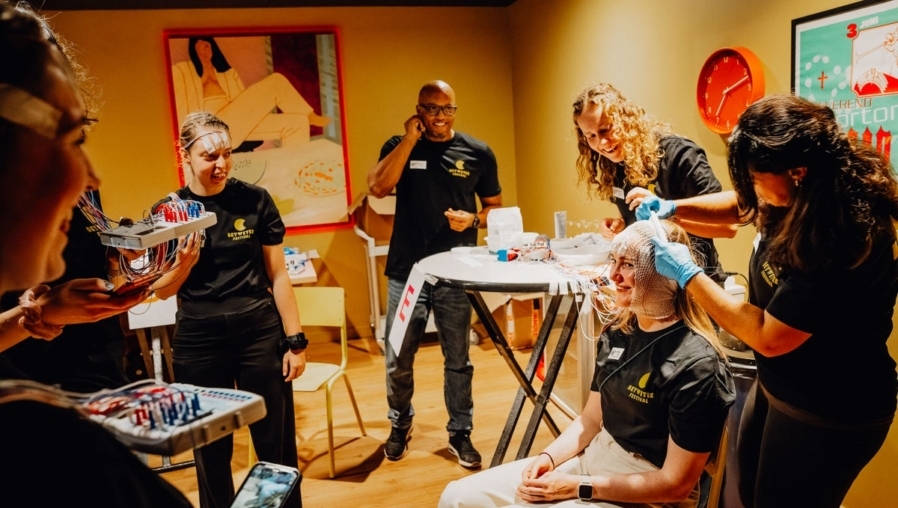
During“X-Ray Your Festival Brain”at Lowlands, visitors can have their own brain waves measured. Using an EEG (electroencephalogram), the team records how a person’s brain reacts to different frequencies of strobe light.
Participants first fill out a short questionnaire and then step into a world that feels like a festival in itself. Lying on a lounge chair and enjoying their favorite music, participants are exposed to light stimuli: first under dimmed lighting, then fully under the strobe. Meanwhile, the researchers measure how the brain reacts to these stimuli. Afterward, the festivalgoers discover which “brain type” suits them best.
From Festival to Better Care
The Lowlands study is part of the REPEAT study, a larger national research project led by UMC Utrecht. This study examines the effect of sleep deprivation and light-flash stimulation on the brains of people with possible epilepsy. “A festival like Lowlands offers a unique opportunity for this,” says Sandra. “Nowhere else can you find so many healthy volunteers who are simultaneously getting little sleep, using recreational drugs, and partying. Scientifically speaking, we know virtually nothing about that exact combination.”
The data the researchers collect at the festival will ultimately contribute to better care for people with epilepsy. “Because we don’t fully understand how healthy brains react to sleep deprivation and substance use, it’s difficult to properly interpret abnormal readings in hospital patients,” says Sandra. “Does a reading indicate epilepsy, or does it have another cause?”
In addition, Sandra hopes to offer concrete guidelines for safer festival policies. “We want to know which strobe frequencies are safe but still create a great party atmosphere,” she concludes. “That way, we hope everyone can enjoy a festival without worry.”