Study on operating using light-emitting neuroblastoma has started
Surgeons and researchers have started a new clinical study. They are investigating the best way to remove neuroblastoma more precisely by making tumour cells light up during surgery. For the first time in the world, doctors at the Princess Máxima Center are applying this method in children.
The study builds on promising results from the laboratory. There, researchers tested a fluorescent substance linked to an existing medication in mini-tumours and in mice. They found that the substance clearly distinguishes between tumour cells and healthy tissue.
In adults, surgery guided by glowing tissue is already used for several types of cancer. The new study, called GLOW-FISH, focuses on children with neuroblastoma. In this type of childhood cancer, it is very difficult to completely remove the tumour during surgery due to the way it grows.
In this study, scientists are investigating what dosage of the fluorescent substance should be given to children. They have already made a good estimate using calculations, but the study will determine the exact amount. They are also examining whether the fluorescent substance truly helps surgeons remove tumour cells more precisely.
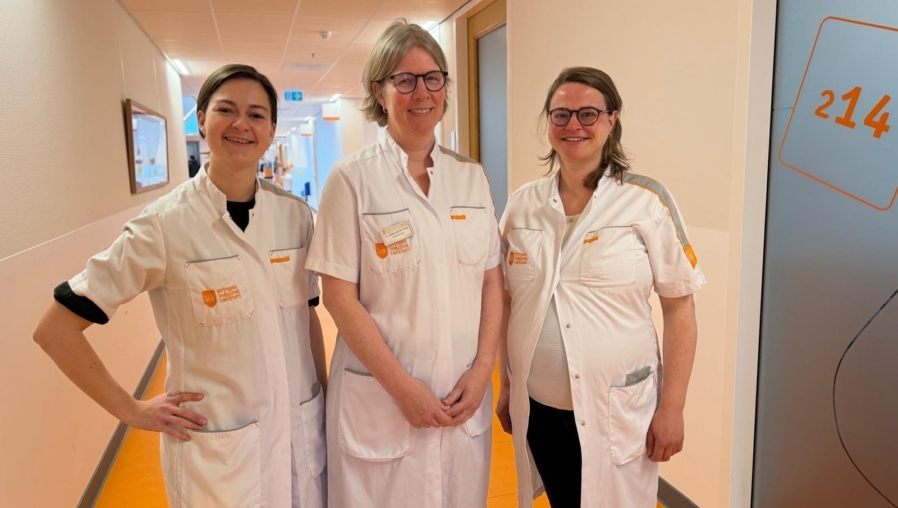
Dr. Willemieke Tummers and Dominique Simons work within the Clinical Research Programme in Oncological Surgery at Máxima and are closely involved as project leader and study coordinator. Tummers says: “We expect that this method will allow us to operate on children more precisely. This is because we can more accurately remove glowing tumour cells while preserving healthy tissue. That could improve the cure rate and quality of life for children with neuroblastoma.”
Around 15 children at Máxima who need surgery for neuroblastoma will take part in this study. Meanwhile, researchers are also exploring whether this surgical method could in the future be used for children with bone tumours.
KWF makes this clinical study possible. Villa Joep previously supported the laboratory research. In that earlier work, researchers tested the fluorescent substance developed by the Clinical Research Programme in Oncological Surgery and the Rios group at Máxima, together with Leiden University Medical Center.
Innovative technologies in the operating room
In this combined phase I-II study, the substance anti-GD2-IRDye800CW is being investigated. This compound consists of a fluorescent label attached to the antibody dinutuximab. This antibody binds to GD-2, which is present on the surface of tumour cells. Dinutuximab is already used as adjuvant therapy in the treatment of neuroblastoma.
The main goal of the study is to determine a safe dosage of this new fluorescent substance. In addition, researchers are evaluating how effectively it can make neuroblastoma cells visible. The Trial and Data Centre of Máxima is coordinating the study.
The use of tumour-specific fluorescence is one of the innovations in surgery being studied at Máxima. Dr. Lideke van der Steeg, head of paediatric surgery and Clinical Research Programme in Oncological Surgery, is the principal investigator of the study. She says: “Together with technical physicians and physician-researchers in our group, we are looking at where innovative technologies can truly make a difference for children with cancer. It is very meaningful that what was developed in the lab is now finding its way into the operating room through clinical research.”
If the study is successful, the researchers plan to launch a follow-up study to evaluate the benefits of fluorescence-guided surgery in a larger group of children. This could eventually give surgeons and children with neuroblastoma both inside and outside Máxima access to this technique.
The fluorescent substance used in the study, linked to dinutuximab, was developed through a collaboration between the Clinical Research Programme in Oncological Surgery and the Rios group at Máxima, together with the Image-Guided Surgery group of Prof. Dr. Vahrmeijer at LUMC.
The fluorescent compound used in the study is prepared in the pharmacy of LUMC. To make this possible, the substance first had to be adapted for use in children. Rob Valentijn and Dr. Martin Pool were responsible for these important modifications.
The clinical study is a collaboration with Recordati, the manufacturer of dinutuximab. Máxima has filed a patent application together with LUMC to protect the combination of dinutuximab and the fluorescent compound anti-GD2-IRDye800CW.