Report: Economic gains are more important than idealism in sustainability efforts
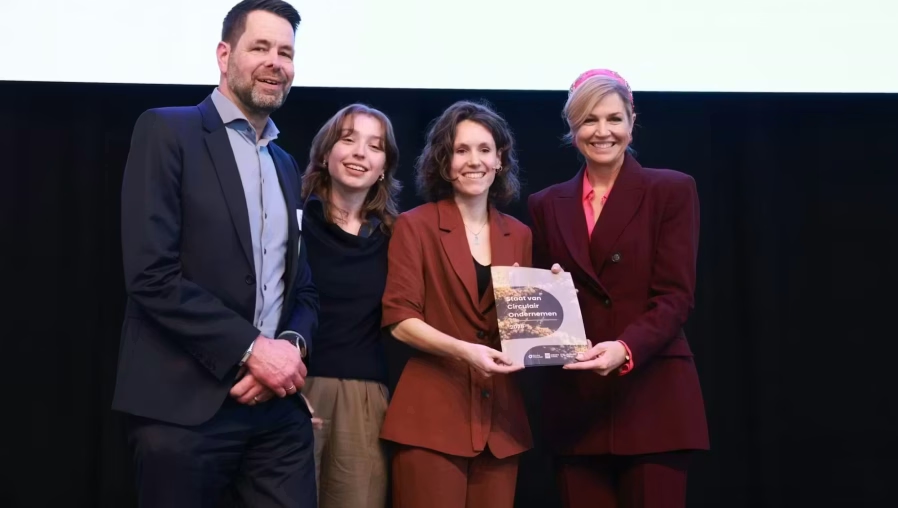
Queen Máxima today received the second edition of the State of Circular Entrepreneurship: a publication by Route Circulair in collaboration with Utrecht University of Applied Sciences and Eindhoven University of Technology. The report reveals a striking pattern: ambition around circularity is growing strongly, but the translation into concrete implementation is lagging behind.
Krista Smit of Route Circulair, an organization in the Netherlands that helps companies with the circular economy, presented the State of Circular Entrepreneurship report to Queen Máxima during the Circular Entrepreneurship Congress in Utrecht. The report, based on more than a thousand measurements across Dutch organizations, shows how far companies in the Netherlands have progressed in circular entrepreneurship and what is needed to accelerate the transition to a circular economy.
From environmental ideal to growth strategy
The report reveals a fundamental shift: “new market opportunities and competitive advantage” is the fastest-growing driver for circularity among Dutch entrepreneurs, an increase of 60% compared to 2024. Cost savings and more efficient use of raw materials as a motivation also rose significantly, by over 52%. At the same time, “environmental impact” as a primary driver decreased by 15.9%. This shift reflects a broader trend: in a time of resource scarcity, geopolitical tensions, and rising raw material prices, companies are increasingly choosing circularity based on economic logic rather than idealism.
Krista Smit of Route Circulair said: “Many organizations are looking for the commercial application of circularity to not only reduce environmental impact, but also achieve financial gains within their organization. In practice, however, this proves difficult to implement, as organizations encounter various barriers.”
Pattern of barriers
Entrepreneurs aiming to accelerate their sustainability efforts face a consistent pattern of obstacles: high investment costs and uncertain returns (17.0%), lack of knowledge and expertise (15.6%), time constraints and limited capacity (13.9%), restrictive or unclear regulations (13.5%), and low customer demand (11.3%).
Arjen Wierikx, researcher at Utrecht University of Applied Sciences and Eindhoven University of Technology, said: “Research shows that implementation often lags behind, because circularity requires new ways of working in processes, business models, and supply chain collaboration. Formulating a strategy is an important step, but developing that organizational capability takes time.”