Rhabdoid tumor cells targeted through their building blocks
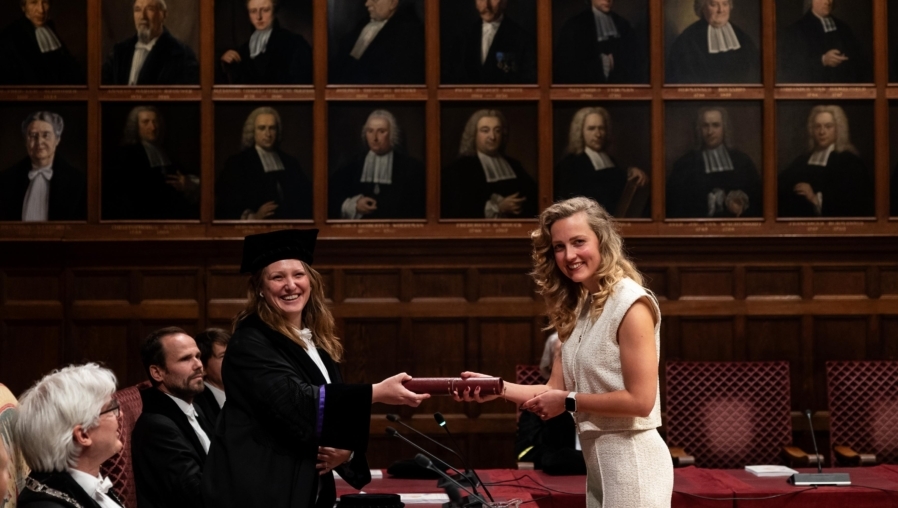
PhD candidate Marjolein Kes has identified new therapeutic targets for the treatment of rhabdoid tumors (MRT). In the laboratory, Kes found that inhibiting the production of DNA building blocks slows the division of tumor cells and can even cause them to disappear. These findings form the basis for the development of a new clinical study. Yesterday, she received her PhD from Utrecht University.
MRT is a rare but difficult-to-treat tumor. Despite intensive treatments, outcomes remain limited for some children. Researchers are therefore searching for new ways to specifically target tumor cells.
Marjolein Kes investigated how these cancer cells use nutrients to grow and which parts of this process contain vulnerabilities that make tumor cells susceptible when disrupted. She conducted this research within the Drost group at the Princess Máxima Center and the Berkers Group at Utrecht University.
Using a range of research techniques, Kes studied mini-tumors grown in the laboratory, also known as organoids. Tumor tissue obtained from the biobank of the Máxima Center was used for this work. In the laboratory, she found that inhibiting the production of DNA building blocks, including by targeting the enzyme DHODH, reduces the growth of cancer cells.
From discovery to application
Following completion of her PhD, Kes will continue working at the Máxima Center in the Drost and Hulleman groups. She is further investigating the existing drug gemcitabine, which acts on the same metabolic process identified during her laboratory research. In addition, the Máxima Center is currently developing a clinical study involving gemcitabine.
‘What I like most about this research is that it has led to concrete next steps for children. We have identified new vulnerabilities that may contribute to better treatments for children with rhabdoid tumors.’
Kes’s PhD research and follow-up research in the Drost and Hulleman Groups are made possible by Stichting Kinderen Kankervrij (KiKa). In 2025, she received the Tom Voûte Award from KiKa, a prize for promising early-career researchers, in recognition of her work.
Metabolic vulnerabilities as therapeutic targets
An important component of Marjolein Kes’s PhD research focused on developing and applying methods to study the metabolism of childhood cancer cells in detail. To achieve this, she combined several techniques, including metabolomics and stable isotope tracing. These techniques were applied to organoids grown in the laboratory. The organoids were generated from tumor material stored in the biobank from children who are receiving or have received treatment at the Máxima Center.
This approach enabled her to track how tumor cells take up and utilize nutrients to support growth. She also investigated which metabolic processes are essential for tumor survival. By integrating gene expression and metabolic data, she obtained a detailed picture of the biological mechanisms driving these aggressive forms of childhood cancer.
Further improving organoid research
A central theme throughout the dissertation is the use of patient-derived organoids. These research models more closely resemble actual tumors than traditional cell cultures and provide a more realistic platform for testing new treatments. Kes explored ways to further improve organoid-based research, including by examining how factors in the tumor microenvironment, such as nutrient availability, oxygen levels, and pH, influence drug sensitivity.
This approach generated new insights into metabolic vulnerabilities. In the laboratory, she found that inhibition of the pyrimidine synthesis enzyme DHODH reduces the number of cancer cells. Pyrimidines are essential building blocks of DNA. Kes is now continuing to investigate inhibition of the pyrimidine pathway as a postdoctoral researcher in the Drost and Hulleman Groups. She is also continuing her work on optimizing organoid culture conditions, creating environments that more accurately reflect physiological conditions and studying the resulting effects on drug sensitivity.
Translating discoveries from the laboratory to the clinic
As a next step following Kes’s findings, research group leader and pediatric oncologist Dr. Reineke Schoot is establishing an international clinical study. This study will investigate whether gemcitabine, a pyrimidine analog, can be effective for children with a rhabdoid tumor. Because the drug is already used in routine clinical practice for other tumors, this study could accelerate the development of improved treatment options.
Kes: ‘It is important to study childhood cancer in models that replicate conditions in the human body as closely as possible. This increases the likelihood that promising laboratory findings can ultimately be translated into better treatments for children.’