Patients are testing a portable artificial kidney at home for the first time
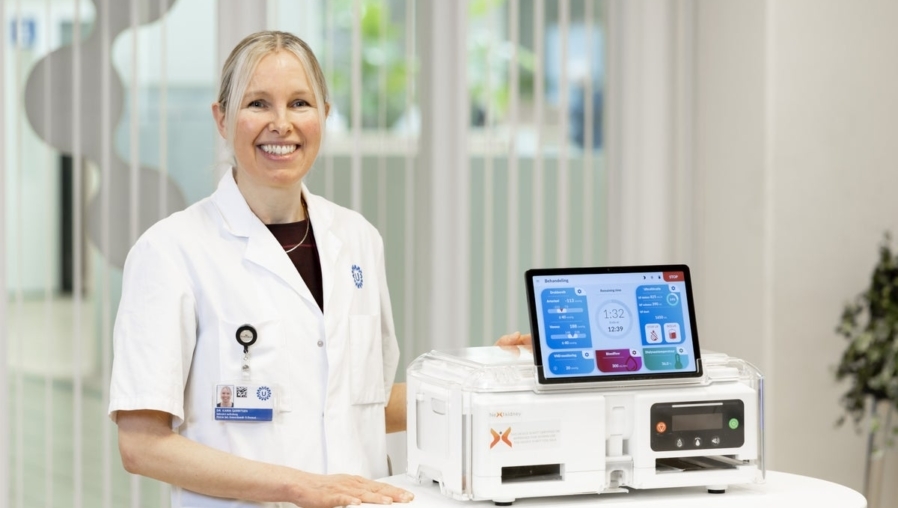
Patients with severe kidney failure often depend on hospital-based dialysis. At UMC Utrecht, patients in the Netherlands are now testing a wearable artificial kidney for the first time, which can be used at home. The first patients are taking part in a clinical study with the so-called NeoKidney. The goal is to give patients more freedom and control in their daily lives, without compromising on safety.
What is kidney failure and why is dialysis needed?
Healthy kidneys filter waste products and excess fluid from the blood. In kidney failure, the kidneys function poorly or stop working altogether. To survive, patients then need a treatment that replaces kidney function, such as dialysis or a kidney transplant. A dialysis session typically lasts four hours and is often required three times a week.
In haemodialysis, the blood is purified through a machine several times a week. This usually takes place in hospital and takes several hours per session. As a result, dialysis has a major impact on work, education, travel and social life. In the Netherlands alone, around 5,000 people depend on haemodialysis. Worldwide, approximately 2.8 million people rely on haemodialysis, and a total of about 3.8 million kidney patients depend on dialysis to survive.
Why a wearable artificial kidney?
“Dialysis is life-saving, but also extremely demanding,” says Karin Gerritsen, nephrologist at UMC Utrecht and principal investigator of the study. “With a wearable artificial kidney, we want to give patients more freedom and make treatment fit better into their daily lives.”
A wearable artificial kidney makes it easier to:
-
Dialyse at home and while travelling
-
Dialyse at flexible times
This can contribute to a better quality of life.
What is the NeoKidney?
The NeoKidney is a lightweight, portable dialysis device, roughly the size of a carry-on suitcase. It has been developed for home use and is based on haemodialysis, but in a much more compact form than current haemodialysis machines.
Unlike standard (home) haemodialysis, no home modifications are required, such as a dedicated water supply and drainage system, additional plumbing, a separate power group or medical grounding. The device is energy-efficient and electrically safe, meaning it can be connected to a standard power socket.
Key features:
-
Portable and designed for use at home and while travelling
-
A closed system with reuse (regeneration) of dialysate
-
As a result, far less dialysate is needed than with standard dialysis (4.5 litres instead of 30 litres or more)
The device is designed for short, frequent haemodialysis sessions: four to seven treatments of two hours per week. This allows the NeoKidney to offer a more gradual treatment than the traditional schedule of three four-hour sessions per week, with fewer fluctuations in fluid levels, waste products and minerals. The device is connected in the same way as regular haemodialysis, via a shunt or catheter.
What is currently being studied?
UMC Utrecht, part of the Utrecht Science Park and affiliated with Utrecht University, is conducting research into the safety and effectiveness of the NeoKidney together with the Dutch Kidney Foundation and medical technology company NextKidney.
Following earlier positive safety studies with previous prototypes in France and Singapore:
-
Around fifty patients will participate in a longer-term study
-
They will also use the device at home
-
Researchers will assess safety, ease of use and effects on daily life
Karin explains: “During this test phase, we assess whether the NeoKidney works properly and safely. First, we examine whether the device sufficiently cleans the blood. We do this by measuring how effectively waste products are removed during every dialysis session. We want to be sure this happens at a reliable and consistent level. We also monitor how much fluid is removed and whether this is done accurately.”
Is the NeoKidney study safe?
“Safety is also crucial,” Karin says. “We carefully track whether any side effects occur during or after dialysis that are related to the device, and whether these are serious. We also monitor changes in things like blood pressure, heart rate and blood values to check whether the body responds well to the treatment.”
“We also look at how comfortable and practical the dialysis process is, and ask patients themselves how they experience the treatment and its impact on their daily lives and quality of life. Halfway through the study, NextKidney will submit the results to an independent certification body. This organisation will assess whether the device is safe and effective enough to be allowed onto the market.”
The goal is to work towards CE certification, possibly in 2026 or 2027. This is required before the device can become available to patients in Europe.
Who is the wearable artificial kidney suitable for?
The device is intended for patients who want to dialyse at home, have stable dialysis sessions, have good vascular access and prefer shorter, more frequent dialysis treatments. It is not yet suitable for children, pregnant women or patients with severe additional conditions such as serious lung or liver disease.
Collaboration between healthcare, science and technology
The development of the wearable artificial kidney is the result of close collaboration between:
-
Healthcare professionals and researchers at UMC Utrecht, from the departments of Nephrology and Medical Technology and Clinical Physics
-
The Dutch Kidney Foundation, which represents the patient perspective
-
NextKidney, responsible for the technological development
“By combining knowledge and experience, we can work step by step towards better kidney care,” says Karin.
What does the future of kidney care look like?
The wearable artificial kidney is an intermediate step towards further innovation. Researchers are also working on a future vision in which dialysis is possible without large devices or needles, for example through implantable technologies. This falls within the broader field of regenerative medicine, which focuses on developing treatments that harness the body’s self-healing capacity.
“That is still a long way off,” Karin emphasises. “But every step brings us closer.”
What does this mean for patients right now?
If the research is successful, the wearable artificial kidney could in the future:
-
Become a complement to existing forms of dialysis
-
Give patients more independence, flexibility and freedom
-
Reduce the number of hospital visits
The study is still ongoing. Results are expected in 2027.