Hope for the PFAS problem?
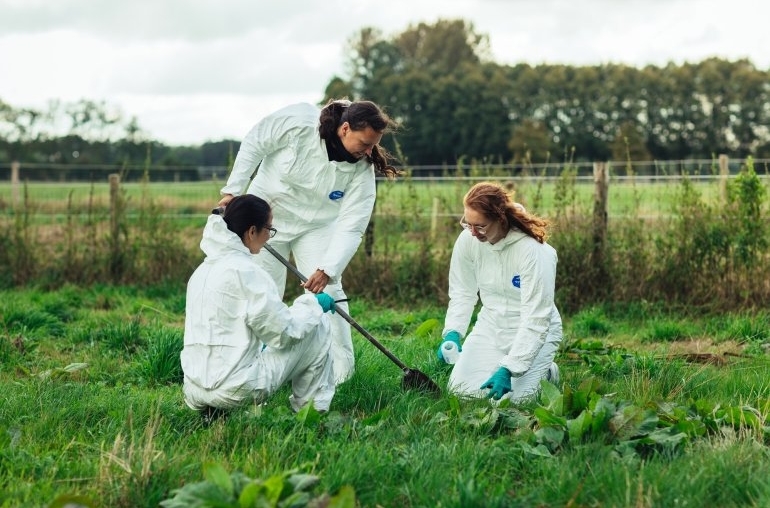
You could walk past it without noticing, the dilapidated little field in Utrecht Science Park. But underneath the grass and weed, much work is being done for a possible solution to one of the most persistent environmental problems of this time: PFAS.
For years, the voluntary fire department of Utrecht University practised with fire and extinguishing foam on the little field. The fact that this foam was chock-full of PFAS is something no one knew at the time. Years later, the soil turned out to be seriously contaminated, like the soil in 20,000 estimated other locations in the Netherlands.
Everywhere and nowhere
PFAS is a collective noun for 12,000 different chemical substances which have been produced and used in food packaging, Teflon-coated pans and electronics for over 50 years already. They make products water and oil repellent, and heat resistant. But those very same properties also make PFAS dangerous. The chemicals are very strong. This is why PFAS are also called ‘forever chemicals’. They accumulate in the soil, in the air, in the ground water and in living organisms. They are in your bloodstream and even in the ice on Antarctica by now.
What does PFAS do in the soil?
Back to the little field. There were talks with the municipality of Utrecht on a solution to the contamination underneath the 3,000 square metres of grass. The municipality stated that the university should just do its own research into it. And that happened,
says coordinator of the PFAS Remediation Living Lab Johan van Leeuwen. This Lab is a collaboration between geologists, hydrogeologists and biologists from the university. On the little field in the Science Park, we learn to better understand the behaviour of PFAS in the environment and we test various ways to clean up the PFAS.
Besides this, the scientists investigate what PFAS does with the soil life and with plants. We develop calculation models to predict the behaviour of PFAS in the soil,
Van Leeuwen says.
Dig and dump
Simply excavating the soil and dumping it in a landfill does not work, Van Leeuwen and his colleagues know. Doing that would in fact relocate the problem. The chemicals are washed out and return to the environment via sediments or purified water. Burning them is a bad option too: a part of the toxic substances are then released into the air and precipitate somewhere else. You understand why PFAS are such a real headache. We’re having a hard time getting rid of them,
Van Leeuwen says. He speaks out in favour of halting the PFAS production AND targeted remediation of the most seriously contaminated locations.
Water and soap
Especially extinguishing foam ‘sticks around’ well in unsaturated soil, which is the ground above the ground-water level. If you only rinse the soil with water, especially the longer PFAS compounds, such as PFOS, simply remain where they are.
Van Leeuwen and his colleagues researched a more sustainable alternative: rinsing the soil with biological soap. This turned out to be remarkably effective. In the first testing phase, we saw that 95 % of PFOS is removed in the process,
Van Leeuwen explains. With just tap water, only 64 % washes away.
Van Leeuwen calls this process competitive desorption: the soap competes with the PFAS in the soil in a way, and wins.
This study by Van Leeuwen and his colleagues (Hibben et al. (2025), Biosurfactant-induced PFAS Leaching from Aqueous Film-Forming Foam (AFFF) Impacted Soil) was published in the academic journal Interpore Journal in late 2025. They mention natural soaps as a promising, sustainable strategy to deal with PFAS contamination, such as in soil contamination with extinguishing foam. Rinse water is collected to prevent relocation of the contamination. The soap which may or may not remain after the rinsing is actually biologically degradable and will eventually disappear.
Searching for new fields
We want to do more tests with various soap concentrations in a wide range of soil types. It is our ambition to apply this technique in multiple contaminated locations in the field. Our own little PFAS field on campus is less suitable for this, because the subsoil consists of badly permeating clay which is several metres thick,
Van Leeuwen says. A sand soil forms a much bigger risk for contamination, because PFAS spread easily in it. The loose structure of sand soils also allows them to be ‘rinsed’ with water and soap more easily, which makes it a logical next step in our further research.
So Van Leeuwen is looking for new ‘little fields’.
Rinsing, pumping, destroying
Is this the big breakthrough which will solve the PFAS problem? Van Leeuwen is careful. He and his colleagues are only at the beginning. Because even if the PFAS are washed out of the soil and the contaminated water has been pumped, you still have the contamination to deal with. Our ambition is to also research the most likely to be successful ways to destroy the PFAS next.
In the meantime, they continue to measure and analyse underneath the clumps of grass in the little field at the Munsterlaan. So the contamination on campus comes in handy in order to do this kind of research close to the university: a unique laboratory by the door. But the little field also serves another role. On top of this, the discovery of the effect of soap makes the little field a booster for follow-up research,
Van Leeuwen concludes.
Text: Carolien Vader
Image: Esther Meijer