Dias group explores overactivation as a new treatment strategy
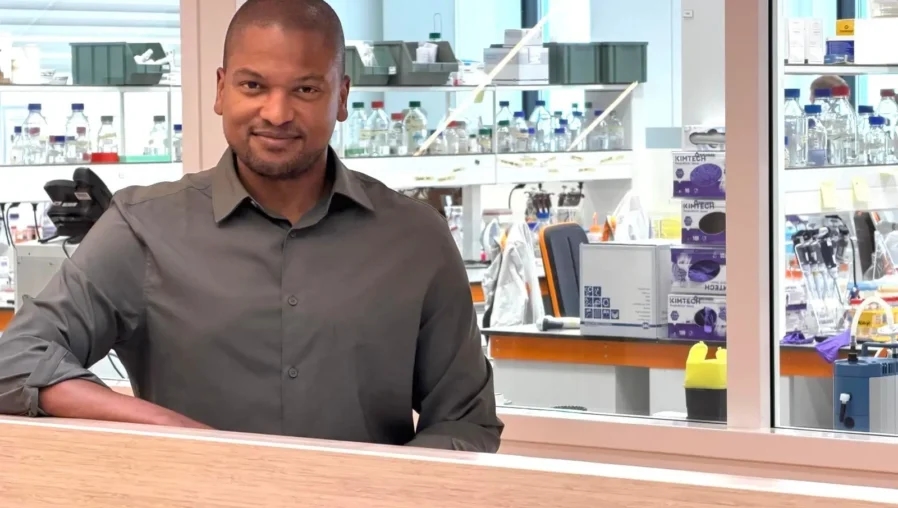
Dr. Matheus dos Santos Dias has started as a group leader at the Princess Máxima Center. Together with his team, he is investigating an innovative idea. Instead of inhibiting signals in cancer cells, they aim to further stimulate these signals to overwhelm and kill the cells. In the long term, this approach may lead to effective and potentially less burdensome treatments for children with cancer.
Matheus dos Santos Dias’ research represents a new research direction within the Máxima. He focuses on deliberately overstimulating growth signals in cancer cells, causing them to overload themselves and eventually die. Healthy cells retain mechanisms to absorb excessive signals; whereas cancer cells have lost much of this control.
‘Cancer cells depend on abnormal growth signals and control systems that do not work as they should,’ says Dias. ‘By stimulating these signals so strongly that they actually work against the cancer cell, we turn an advantage into a weakness. This opens up new possibilities for treatments that more specifically target cancer cells.’
Dias previously investigated this principle in Ewing sarcoma, a type of childhood cancer. At the Máxima, he will continue this work thanks to funding from the Children Cancer-free Foundation (KiKa). He also aims to apply this approach to other forms of sarcoma and difficult‑to‑treat pediatric cancers, in collaboration with various research groups.
‘I hope we can further develop this fundamentally different approach into future treatments, especially for children. They still have their whole lives ahead of them, which makes it important to develop new treatments that are both effective and support an optimal quality of life during and after treatment.’
Prof. Dr. René Medema, Scientific Director of the Princess Máxima Center, says: ‘With his innovative research, we are adding a new approach specifically targeting cancer cells to our research programs. We also welcome a creative, out‑of‑the‑box thinking research group leader. I am therefore very pleased to welcome Matheus dos Santos Dias to our research community.’
Previously, Dos Santos Dias worked in the research group of Prof. Dr. René Bernards at the Netherlands Cancer Institute (NKI). He studied and obtained his PhD at the University of São Paulo in Brazil.
While most therapies inhibit oncogenic signaling pathways, Dias’ group focuses on a fundamentally different approach to cancer treatment: activating these signals. This approach is called Therapeutic OVERactivation of oncogenic signaling (TOVER). The principle is that cancer cells are highly dependent on elevated growth signals to survive, but as a result are also constantly under stress. By further increasing this signaling, the balance may tip, causing tumor cells to lose their ability to survive.
The research group focuses on identifying targets within the cell to make TOVER possible, for example by directly activating signaling pathways or disabling inhibitory control mechanisms. The team is also investigating how this strategy can be combined with treatments that target stress response mechanisms in tumor cells.
Together with research groups at the Máxima, Dias focuses on different forms of sarcoma and difficult‑to‑treat pediatric cancers. In doing so, he also makes use of the expertise and opportunities provided by the research facilities at the Máxima.
Dias: ‘I have always dreamed of making an impact on people’s lives through my research. I believe our different approach may be very relevant for pediatric oncology. Because healthy cells retain their internal control systems and are better able to absorb excessive signaling. This may create opportunities for more effective treatments with less damage to healthy tissue and fewer long-term adverse effects. And that is so important for the children being treated at the Máxima Center.’