Building energy independence at the Utrecht Science Park
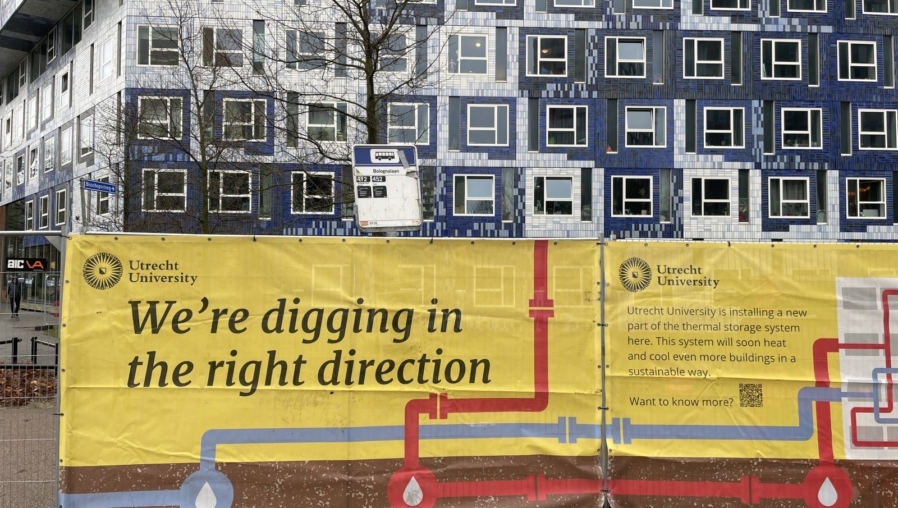
At the Utrecht Science Park, five institutions are joining forces to develop a collective aquifer thermal energy storage system (ATES). With this initiative, they are taking an important step toward a future-proof, largely fossil-free energy system. A thermal source for heating and cooling is currently being installed to connect the first buildings. By 2030, several more buildings are expected to be linked to this shared infrastructure. By mutually sharing heat and cold, the campus will significantly reduce its reliance on natural gas and external energy sources.
What stands out most is the collaboration, says Katelien van den Berge, an independent energy systems researcher who studied the project as part of a comparative analysis of low-temperature heat networks in Dutch cities. “It’s an impressive development,” she says. “Not so much because of the technology itself, but because of the scale of the collaboration, the long-term vision, and the courage to start implementing it already.”
“This is exactly the kind of system approach we need in Utrecht to gradually become less dependent on fossil fuels.” – Alderman for Energy and Climate, Senna Maatoug
Storing energy underground
The principle behind a thermal energy storage system (ATES – Aquifer Thermal Energy Storage) is relatively straightforward. Instead of generating heating and cooling on demand, the system stores heat and cold in underground aquifers, which are then distributed later via a shared network of wells and heat exchangers to connected buildings.
The system uses two separate groundwater sources: one for heat storage and one for cold storage. In summer, water from the cold source is used to cool buildings. The heat released in the process is then stored in the warm source. In winter, that stored heat is pumped back up to heat buildings, while the cooled water flows back into the cold storage. In this way, heat and cold are not lost between seasons, but retained and reused.
“Surpluses of heat or cold in one building can be used to compensate for shortages in another.” – Jolt Oostra, Energy Portfolio Manager, Utrecht University
The real efficiency gains occur when multiple buildings are connected to the same ATES system. “Surpluses of heat or cold in one building can be used to compensate for shortages in another,” explains Jolt Oostra, Energy Portfolio Manager at Utrecht University. “This significantly reduces the need for natural gas, lowers CO₂ emissions, and cuts energy costs.”
More efficient together
ATES systems are not new in the Netherlands. What makes the system at Utrecht Science Park unique is the scale and intensity of the collaboration behind it. “There were already thermal energy storage systems at the Science Park,” says Oostra. “But they were managed separately by different organizations. In recent years, five institutions have worked together to integrate these systems into one collective network.”
These partners are Utrecht University (UU), Utrecht University of Applied Sciences (HU), the student housing foundation SSH, the International School Utrecht (ISU), and the University Medical Center Utrecht (UMC Utrecht).
At present, the first underground heat and cold source is being developed, with enough capacity to connect the initial buildings to the collective ATES system: the Utrecht University Library (UBU), International School Utrecht (ISU), and Utrecht University of Applied Sciences (HU). The system will expand in line with the campus’s needs. “The more diverse the energy profiles of the connected buildings, the more efficient the system becomes,” says Oostra. “A building that produces a lot of residual heat can help heat nearby classrooms. Heat released from cooling buildings with high solar exposure can be used elsewhere on campus for heating.”
Part of a broader energy transition
Alderman for Energy and Climate Senna Maatoug: “As a city, we are growing rapidly. That means we need to use energy and the limited space in our subsurface more intelligently. Collective systems like this at Utrecht Science Park show how collaboration can lead to more efficient, sustainable, and future-proof development. This is exactly the kind of system approach we need in Utrecht to gradually reduce our dependence on fossil fuels.”
The municipality brought the parties together, facilitated the discussions, and provided a one-time subsidy to enable the collective solution. Although a shared infrastructure requires a higher initial investment than individual systems, it delivers long-term societal value: more efficient use of underground space, less energy loss, and better opportunities to exchange heat and cold.
A model beyond Utrecht
That broader significance stands out most to Katelien van den Berge, now working as program manager at Collective Heat Amsterdam (CWA) on scaling up thermal energy systems. “I have great admiration for Utrecht University and all the collaborating partners,” she says. “It’s not easy and it takes time. But ultimately, I am convinced it will pay off — economically, ecologically, and socially.”