600 Students Combine Knowledge to Improve Gastric Cancer Care
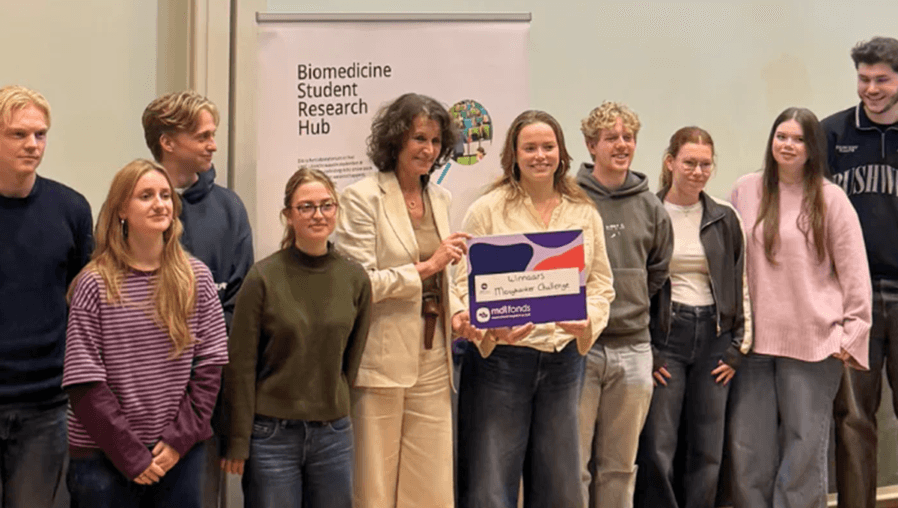
How can we improve care for people with hereditary gastric cancer? This was the question that nearly 600 bachelor’s students from the Faculty of Medical Sciences explored over four weeks during the Gastric Cancer Challenge, organised by UMC Utrecht and the MDL Fonds. On 13 November, the student teams presented their 24 research proposals during the final. Three winning ideas were selected for further research, demonstrating how students can bring a fresh perspective to complex challenges in patient care.
From Patient Questions to Innovative Research
For people with a hereditary predisposition to gastric cancer, the impact on their lives can be enormous. In the Netherlands, approximately 40 families are known to carry a so-called CDH1 mutation. This inherited genetic alteration significantly increases the risk of an aggressive form of gastric cancer. Because this type of cancer is difficult to detect at an early stage, carriers often choose to have their stomachs surgically removed as a preventive measure. This is a major operation with significant consequences for their daily lives.
Important questions remain unanswered. Why do some microscopic abnormalities develop into aggressive gastric cancer while others do not? And how can we better identify these differences so that patients can receive more targeted treatment in the future?
These questions from clinical practice formed the starting point for the Gastric Cancer Challenge, a unique initiative by UMC Utrecht in collaboration with the MDL Fonds. More than 600 students from the Bachelor’s programmes in Biomedical Sciences, Medicine and Clinical Health Sciences worked together with physicians, researchers, patients and other experts to develop new research ideas.
Winning Students Surprise with Fresh Perspectives
During the final on 13 November, the selected student teams presented their proposals to an expert jury. From the 24 research proposals, the jury ultimately selected three overlapping proposals as winners.
The team behind the first winning proposal focuses on understanding how gastric cancer develops. Their idea explores how changes in the environment surrounding tumour cells contribute to the growth and spread of gastric cancer. This could help predict which early abnormalities are likely to develop into cancer and how this process might be prevented.
The students behind the second and third winning proposals aim to identify a marker on abnormal cells that could be targeted through immunotherapy. They plan to investigate which proteins are present on the surface of early gastric cancer cells. These proteins could potentially be used to target and eliminate abnormal cells with the help of immune cells, thereby preventing gastric cancer.
According to the jury, the three proposals stood out for their innovative ideas, strong scientific foundations and well-considered research plans. The jury particularly appreciated the creative combination of techniques, interdisciplinary collaboration and the potential to improve future gastric cancer treatment.
“Working with students from other degree programmes was a real eye-opener. We realised that it allowed us to approach the problem from a completely different perspective. This helped us combine our strengths and develop a research proposal together.”
Winning team, Biomedical Sciences students
Strengthening the Connection Between Education, Research and Patient Care
The Gastric Cancer Challenge demonstrates how education, scientific research and patient care can reinforce one another. Students are not working on a fictional assignment, but on a real challenge faced by patients and researchers. By combining knowledge from different academic disciplines, new perspectives and research ideas emerge.
At the launch of the challenge, Niels Bovenschen, Professor of Biomedical Research-based Education at UMC Utrecht, emphasised the strength of this approach:
“With 600 students from different degree programmes, we can approach a research question from many more perspectives simultaneously than in a regular research project. It is precisely this combination of fresh thinking, diverse disciplines and direct collaboration with physicians, patients and the MDL Fonds that can lead to unexpected new research questions and solutions. Without the collaboration with the MDL Fonds, this would never have been possible in this way.
At the same time, students develop skills they will need later in their careers as healthcare professionals or researchers: looking beyond the boundaries of their own disciplines, collaborating across fields and connecting scientific knowledge to the prevention of disease before someone becomes a patient.”
From Research Proposals to New Insights
The final marks the end of the first phase of the Gastric Cancer Challenge, but not the initiative itself. In phase two, approximately 35 students will further investigate the selected research ideas at research hubs within the Student Research Hub Network of Utrecht University and UMC Utrecht. As part of the Experimental Translational Medicine elective course, students will work alongside experts in fields including biomedical research, biotechnology, artificial intelligence (AI), epidemiology, medical humanities and patient perspectives.
The researchers hope this will lead to new insights into the development of hereditary gastric cancer. Martijn Gloerich, researcher in Molecular Cancer Research at UMC Utrecht, explains why this is important:
“We see many microscopic abnormalities in carriers of a CDH1 mutation, but we still do not fully understand why some develop into aggressive gastric cancer while others do not. Gaining a better understanding of the molecular changes involved could ultimately help us assess risks more accurately and develop more targeted treatments. Moreover, these insights could also be relevant to non-hereditary forms of gastric cancer, which are much more common.”
June 2027: What Will the Students Have Achieved?
From April 2027 onwards, students and researchers will continue working on the selected ideas. The results will be presented at a closing symposium for the Gastric Cancer Challenge at the end of June 2027. What new insights will the research have generated? And what will students have learned from working together on a real-world challenge in patient care?
This marks the beginning of the next chapter in this unique collaboration. Because the Gastric Cancer Challenge is not just about generating new research ideas, but also about educating a new generation of professionals who will work together to shape the future of healthcare.