Interview with Arjen Gerritsen – Chair of the Supervisory Board of the Utrecht Science Park Foundation
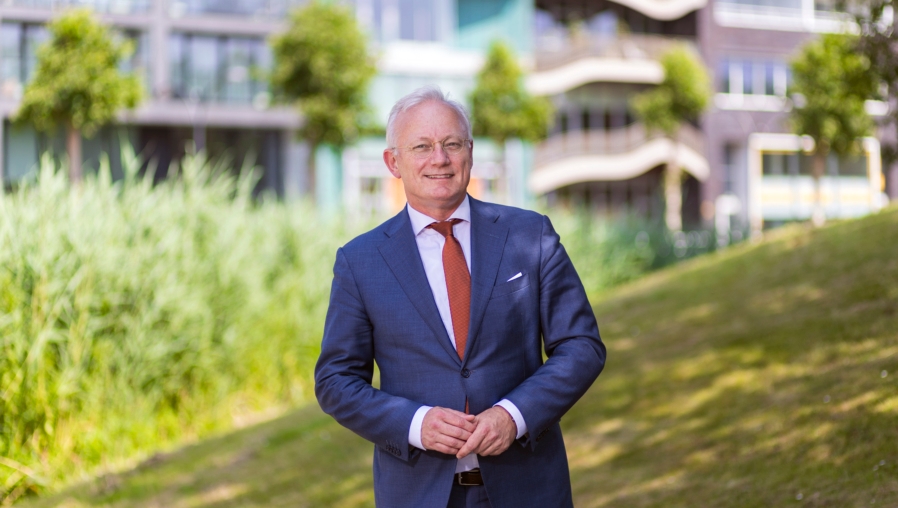
Arjen Gerritsen has served as the independent Chair of the Supervisory Board of the Utrecht Science Park Foundation since 2025. With a career spanning from local government to his current position as King’s Commissioner (CdK) of the Province of Flevoland, Gerritsen brings broad administrative experience and perspective to Utrecht Science Park. We spoke with him about his career, his connection to Utrecht, and the opportunities and challenges facing Utrecht Science Park in the years ahead.
Gerritsen began his career in Twente, where he became politically active at a young age after studying fiscal economics at the Hogeschool Enschede. “In 1994, I joined the municipal council of Wierden, and not long after I became an alderman there,” Gerritsen explains. “You start very locally, but over time you realize how interconnected everything is.”
That development accelerated quickly. In 2002, at the age of 32, he became mayor of Haren, making him the youngest mayor in the Netherlands at the time. This was followed by mayoral positions in De Bilt and Almelo, where he was nominated Best Local Administrator in 2017. Since 2023, he has served as King’s Commissioner in Flevoland.
“When you look back, you see your world gradually becoming larger,” he says. “You begin in a village, then move to a region, and eventually you start looking at the Netherlands as a whole. But the core question remains the same: how do you organize society in the best possible way?”
That question has been a consistent thread throughout his career and aligns closely with his involvement at Utrecht Science Park. “Early in my career, I became fascinated by the collaboration between government, businesses, and knowledge institutions, what we now call the ‘triple helix’. As a mayor, you are right in the middle of it and you see how decisive that collaboration can be.”
During his time as mayor of De Bilt, that fascination became more concrete. The region was dealing with major developments surrounding the RIVM, the KNMI, and the Dutch Vaccine Institute, while at the same time new healthcare and research initiatives were emerging.
“We were facing a strategic question,” he explains. “How could we ensure that our region remained connected to the growth of Utrecht Science Park? The departure and transformation of major institutes had an impact, but they also created opportunities.”
The solution lay in strengthening connections. “At that time, we introduced the idea of a ‘Life Sciences axis’ extending towards Bilthoven. It was partly a vision and partly positioning. You give a development a push and a narrative. And it resonated.”
In the years that followed, that idea evolved into a broader network, with locations in Bilthoven and Zeist also becoming part of the ecosystem. “It is rewarding to see how something that once started as an idea can develop into a concrete structure. It shows what collaboration and long-term thinking can achieve.”
In his current role as Chair of the Supervisory Board of the Utrecht Science Park Foundation, Gerritsen consciously takes on a different position. “The substantive work lies with the partners on the campus: the university, the university of applied sciences, the UMC, companies, and other institutions. My role is to ensure that collaboration runs smoothly, that interests remain balanced, and that parties continue to find each other.”
That connecting role reflects what he has learned throughout his career. “We need to move away from thinking in borders. Municipal and provincial borders are administrative agreements, but for people and businesses they do not really exist. Students, researchers, and entrepreneurs move wherever opportunities are.”
According to Gerritsen, this requires a different mindset, especially in the Netherlands. “If you zoom out, the Netherlands is essentially one large campus. Municipal and provincial borders are just dotted lines on a map. People live in one place, study somewhere else, and work elsewhere again. Everything is interconnected. That awareness should play a much stronger role in policymaking and collaboration. I believe it is extremely important that governments in particular learn to recognize this. We can think much more in terms of people’s systems than in the boundaries of our own territories.”
He also recognizes this broader perspective in his current work in Flevoland. “Here too, you see the same dynamics as around Utrecht: growth, new collaborations, and increasingly strong connections between education, research, and business.”
For Utrecht Science Park, he sees a strong starting position. “The combination of medical research, technological innovation, and talent makes it a unique place. Its central location and accessibility also make it highly attractive for companies and institutions.”
“The combination of medical research, technological innovation, and talent makes it a unique place.”
At the same time, he warns of growing competition. “More and more locations are positioning themselves as science parks, both nationally and internationally. That means you have to continue investing in your distinctiveness and clearly communicate where your strengths lie.”
One important challenge is space. “The area is growing, but like any area, it also faces physical limitations. That requires smart solutions: densification, collaboration with other locations, and strategic choices about what happens where.”
Livability also plays an important role. “A science park that only functions during office hours is not using its full potential. More housing creates vibrancy, amenities, and a stronger community. Ultimately, you want to create an area where people not only work and study, but also live.”
Accessibility remains another key focus point. “A lot has already been invested, for example in the tram system, but pressure on infrastructure continues to increase. If you want to keep facilitating growth, mobility needs to develop alongside it in a sustainable and scalable way.”
Gerritsen also emphasizes the importance of retaining economic growth within the Netherlands. “We are good at starting companies, but less successful at helping them scale up. When successful companies leave, we lose value. We need to ensure that we can accommodate that growth here.”
“When successful companies leave, we lose value. We need to ensure that we can accommodate that growth here.”
This requires strong framework conditions, from financing and fiscal policy to talent development and spatial planning. “The entire ecosystem has to function well in order for companies to grow and stay. That is also reflected clearly in the recent report by Peter Wennink.”
At the national level, he also sees an important challenge. “We need to think less in terms of competition between regions and more in terms of collaboration. What happens in Eindhoven, Leiden, Amsterdam, or Twente affects Utrecht, and vice versa. The Netherlands is small, everything is interconnected.”
That necessity is reinforced by international developments. “Geopolitics, the energy transition, raw materials, all of these factors influence how we position ourselves as a country. It requires investments in knowledge, innovation, and independence.”
Finally, he stresses the importance of long-term thinking. “Everything you develop today will have an impact for decades to come. That sometimes means making difficult decisions, but standing still is not an option. If you are not growing, you are falling behind.”
For Gerritsen, his role at Utrecht Science Park therefore feels like a logical next step. “It brings together everything I have worked on throughout my career: collaboration, development, and societal impact. And what makes it special is seeing how ideas from the past continue to shape the future. Contributing to that is personally meaningful to me as well.”
Positions held by Arjen Gerritsen
| Years | Position |
|---|---|
| 1994–2002 | Member of the Municipal Council of Wierden |
| 1994–1998 | Parliamentary Group Leader of the VVD in Wierden |
| 1998–2002 | Alderman of Wierden |
| 2002–2007 | Mayor of Haren |
| 2007–2016 | Mayor of De Bilt |
| 2016–2023 | Mayor of Almelo |
| 2023–present | King’s Commissioner of Flevoland |